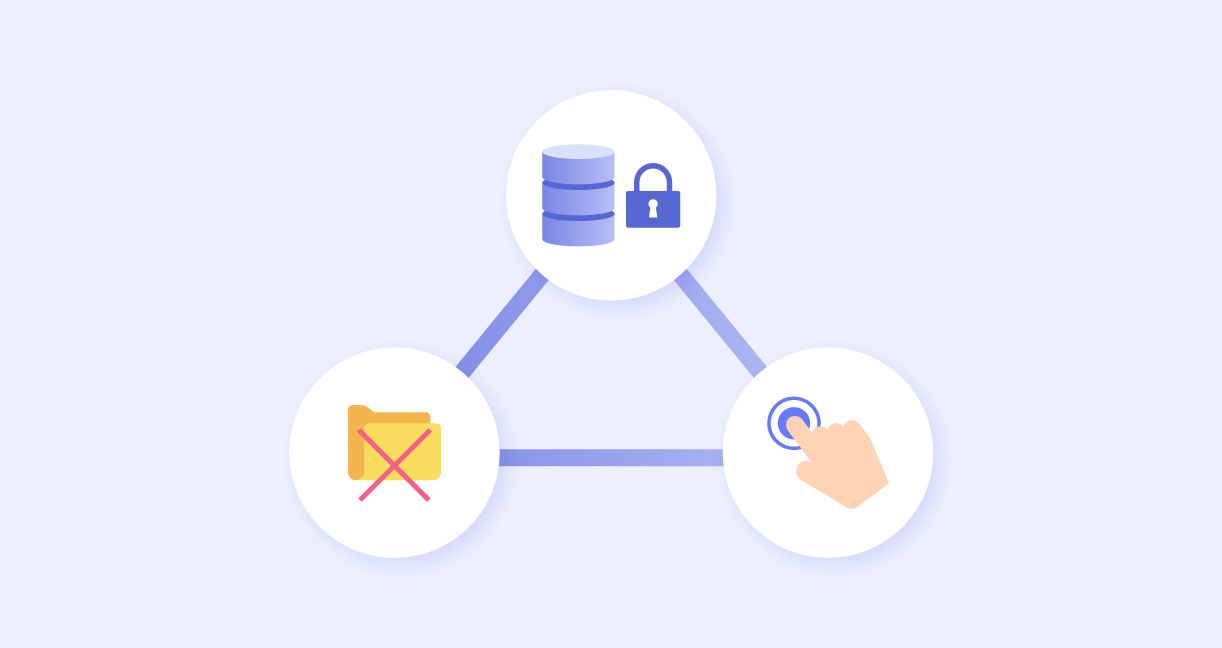


What This Post on AI Coding Agent Credentials Management Covers
-
Credential sprawl happens when AI coding agents automatically ingest sensitive tokens from files, APIs, IDEs, and cloud environments without explicit user action, dramatically expanding the exposure surface.
-
These agents require access credentials to interact with tools like version control, CI/CD pipelines, internal APIs, and MCP servers, making credential management critical for security.
-
To combat sprawl, the blog emphasizes least privilege access, role-specific token issuance, and credential scoping, in alignment with zero trust principles.
-
Credential rotation strategies, such as short-lived tokens, event-based refreshes, and vault integrations, are key to reducing long-term exposure risk, especially in fast-moving, automated systems.
-
Solutions like Kirin control agent permissions at the IDE level, enforcing boundaries and redacting secrets to prevent agents from ingesting unnecessary or dangerous credentials.
Why AI Coding Agents Need Credentials in the First Place
AI coding agents now touch more credentials than most developers and they do it automatically, making AI coding agent credentials management a first-class requirement. They connect to APIs, repositories, local runtimes, cloud environments, databases, and internal developer tools without requiring explicit user action. They collect environment variables, inspect project metadata, and read configuration files to improve their reasoning. This automatic ingestion expands their exposure surface, the complete set of files, variables, and tool outputs an agent can read, and exposes them to sensitive information at every interaction point.
As teams add more tools, plugins, and automations, the amount of stored or cached credentials multiplies. The problem becomes visible when credentials accumulate across multiple agents, extensions, MCP tools, and integrations. This creates a high-risk sprawl that spreads across cloud services, IDEs, and local environments, increasing the blast radius of any compromise. Managing these credentials is now a core responsibility in secure AI-driven development workflows. Without proper management, the ecosystem becomes difficult to audit and can expose multiple layers of developer identity.
IDE Integrations
AI coding agents in IDEs depend on direct Git integration to read branches, commit changes, and detect code history. They also require access to local files because they analyze entire directories to understand the project structure. They can read environment variables, which often contain session tokens, cloud keys, and AI agent access control credentials for testing and safe deployment. IDEs expose workspace metadata to agents so they can track file relationships and dependency graphs. This metadata sometimes includes paths to configuration files that contain secrets.
Recent data shows the scale of credential exposure is growing rapidly, with GitGuardian’s 2024 The State of Secrets Sprawl reporting more than 12.7 million hard-coded secrets detected in public GitHub commits in 2023. Many of these originated from leaked environment variables and configuration files. GitGuardian notes that mismanaged environment variables and configuration files are among the most common origins of leaked secrets because developers frequently store access tokens, API keys, and cloud credentials inside them. A critical nuance is that agent ingestion occurs silently, meaning developers rarely see what the agent has absorbed into its context window, even when those files contain sensitive values. When AI coding agents automatically ingest these files, they inherit the same exposure risk.
Cloud & API Access
AI agents need tokens for cloud deployments because they often generate infrastructure code or trigger automated build steps. They use credentials to interact with CI/CD pipelines, which rely on service tokens for authentication. Internal APIs require specific keys so agents can fetch schemas, test endpoints, or validate code against live systems. Secrets retrieval systems also require authentication, so agents must carry keys to pull configuration values during development. This creates a dependency chain where each step requires different credentials.
According to Kroll’s Q4 2024 Cyber Threat Intelligence Report, compromised account credentials accounted for 27% of initial malicious access events. When multiple AI coding agents reuse overlapping or long-lived cloud keys, the risk multiplies.
MCP Tooling & Plugins
MCP servers introduce additional credential requirements because each server may maintain its own authentication logic. To clarify, Model Context Protocol is a standard that enables AI agents to interact with external tools, APIs, and services through structured, permission-controlled operations. Some MCP tools need service accounts to perform operations such as fetching datasets, running analysis tasks, or interacting with external APIs. Temporary tokens are often issued to MCP plugins to enable short-lived actions, but these tokens still enter the agent's context window. Database access credentials are also passed into MCP tools when agents need to read or modify structured data. As developers install more MCP plugins, each integration adds another credential path to the agent workflow. The expanding set of tools creates a layered environment where secrets multiply quickly. Every new integration becomes another credential that must be protected, tracked, and revoked when risk increases.
Core Principles for Managing AI Coding Agent Credentials
Management of AI coding agent credentials sits at the center of AI coding agent governance and begins with reducing unnecessary access. The more permissions an agent has, the greater the chance it will expose or misuse them. Organizations need to define clear boundaries for every AI agent, including which files, APIs, and services it may access. This prevents credential sprawl by forcing intentional control. Strong isolation policies ensure that a credential used for one task does not bleed into another. Auditing these boundaries helps teams understand when an agent crosses into unsafe territory, and this can be done with lightweight logging frameworks, IDE-level audit logs, or agent wrappers that capture every request the agent makes. Good practice aligns with zero trust principles, which assume no agent is trustworthy simply because it is installed locally.
Least Privilege for AI Agents
Least privilege for coding agents ensures they receive only the minimum permissions required to perform their functions. This means restricting access to files relevant to the specific task rather than granting read access to the entire project. It also means limiting network access so the agent cannot communicate with external services unless it is intended. Splitting credentials into read-only and write-enabled keys prevents an agent from modifying systems it should only observe. For example, a testing agent may need read-only access to production logs but should never hold a token that allows it to deploy or modify services. This reduces the blast radius if a credential is exposed.
Role-Specific Token Issuance
Role-specific token issuance assigns one token per function instead of per developer or per tool. This allows teams to isolate credentials based on what an agent is expected to do. For example, a test token should not grant deploy permissions. This kind of separation makes auditing far simpler because each token maps to a single role. When incidents occur, teams can revoke only the affected token without disrupting other functions. This strategy also avoids a typical pattern in which a single high-privilege token is reused across multiple agents, thereby increasing the risk of credential sprawl. This principle aligns with broader industry findings that credential misuse remains a leading cause of breaches, making it critical to restrict each token to the smallest functional scope possible.
Scoping Credentials
Scoping credentials restricts their use to very narrow conditions, such as directory paths, time windows, specific environments, or allowed commands. Credentials tied to a directory can only be used within particular project folders, preventing agents from reading other areas. Time-scoped credentials expire quickly, so they cannot be reused for prolonged attacks. Environment-based limits ensure that keys valid in staging cannot be used in production. IP or network-scoped tokens prevent access from unknown locations. Command-limited credentials restrict sensitive operations such as deployments or destructive actions. Effective scoping must be enforced through actual tooling such as IAM policies, OPA-based rule systems, or automated policy engines, rather than relying solely on written guidelines or developer discipline.
Zero Trust for AI Agents
Zero trust means treating AI coding agents as external automations rather than as extensions of the developer’s identity. The agent must authenticate for every action instead of inheriting broad trust from the IDE. It cannot access any resource unless explicitly granted access. This approach prevents agents from silently accumulating privileges over time. It also ensures that even if an agent is compromised, it cannot freely move across systems. Zero trust policies require continuous validation, which blocks unsafe requests coming from agents. Unlike older perimeter-based trust models, which assumed internal systems were safe by default, Zero trust removes implicit trust entirely and treats every agent action as potentially untrusted unless validated.
Credential Rotation Strategies for AI Coding Agents
Any serious approach to securing AI coding agents must treat credential rotation as a non-negotiable control, not an optional hardening step. Credential rotation strategies reduce the risk of long-lived token exposure. Short-lived tokens limit how long a stolen credential remains useful. Event-based rotation ensures that tokens refresh whenever agents interact with new resources or when anomalies occur. Vault-based rotation automates the issuance and expiration of secrets, so humans do not have to manage them manually. Automatic revocation policies detect misbehavior and revoke access to credentials before damage spreads. Regular rotation is critical because AI agents operate in environments where secrets are easily ingested or cached.
This challenge is amplified by the latest State of Security 2025 research that indicates 46% of security teams report spending more time maintaining their tools than actively defending their organization, making automated rotation essential rather than optional.
Short-Lived, Ephemeral Tokens
Short-lived tokens expire quickly, limiting the time an attacker can use a stolen credential. These tokens are often valid for minutes or hours rather than days or weeks. They reduce reliance on long-lived secrets, which are among the most significant risk factors in automated environments. AI agents can request new tokens automatically when needed, so they do not rely on static keys embedded in files. Ephemeral tokens also simplify revocation because they disappear naturally without manual cleanup. Many cloud platforms now support these identities by default because they drastically reduce the risk of misuse. This approach helps control credential sprawl by ensuring tokens do not accumulate across multiple agents.
Event-Based Rotation
Event-based rotation triggers credential refreshes in response to specific events, such as agent failures or repository onboarding. If an agent exhibits unusual behavior, the system can rotate its keys immediately. When developers add new repositories, tokens associated with previous projects are refreshed to prevent cross-project access. Rotation also follows incidents like suspicious file access or unexpected network calls. Detecting anomalies allows the system to revoke compromised keys before they are abused. This system aligns with modern security monitoring practices where anomaly detection identifies credential misuse events early. Automatic rotation helps ensure that AI agents do not continue operating with stale or risky credentials.
Rotation via Vault Integration
Vault integration centralizes secret storage while automating token rotation. AI agents request these credentials dynamically instead of storing them locally. The vault logs every access attempt, which helps security teams identify suspicious usage patterns. Vaults also encrypt credentials at rest and enforce strict access policies. This reduces the number of unmanaged tokens spread across the development environment. By relying on vault-based systems, teams avoid embedding secrets in configuration files or IDE settings.
Automatic Revocation Policies
Automatic revocation policies immediately invalidate keys if an agent crosses defined boundaries. When a policy violation occurs, the system revokes all associated credentials to prevent further misuse. Revocation is triggered when an agent attempts unauthorized commands, reads restricted files, or performs unexpected network actions. These policies ensure fast containment even when developers are not monitoring. Real-time revocation reduces the time window for attackers to exploit.
Controlling Credentials at the IDE + Agent Layer
Controlling credentials at the IDE and agent boundary has become one of the most essential parts of secure AI-assisted development. AI coding agents operate within the editor, reading files, environment variables, metadata, logs, and configuration information. This means the IDE becomes the source of truth for everything an agent can access, including sensitive tokens. Without strict access controls, an agent may unintentionally ingest secrets or reuse cached credentials across workflows.
Verizon’s 2025 Data Breach Investigations Report explicitly notes a high prevalence of breaches involving stolen credentials within web application attack patterns, reinforcing the danger of uncontrolled access at this boundary.
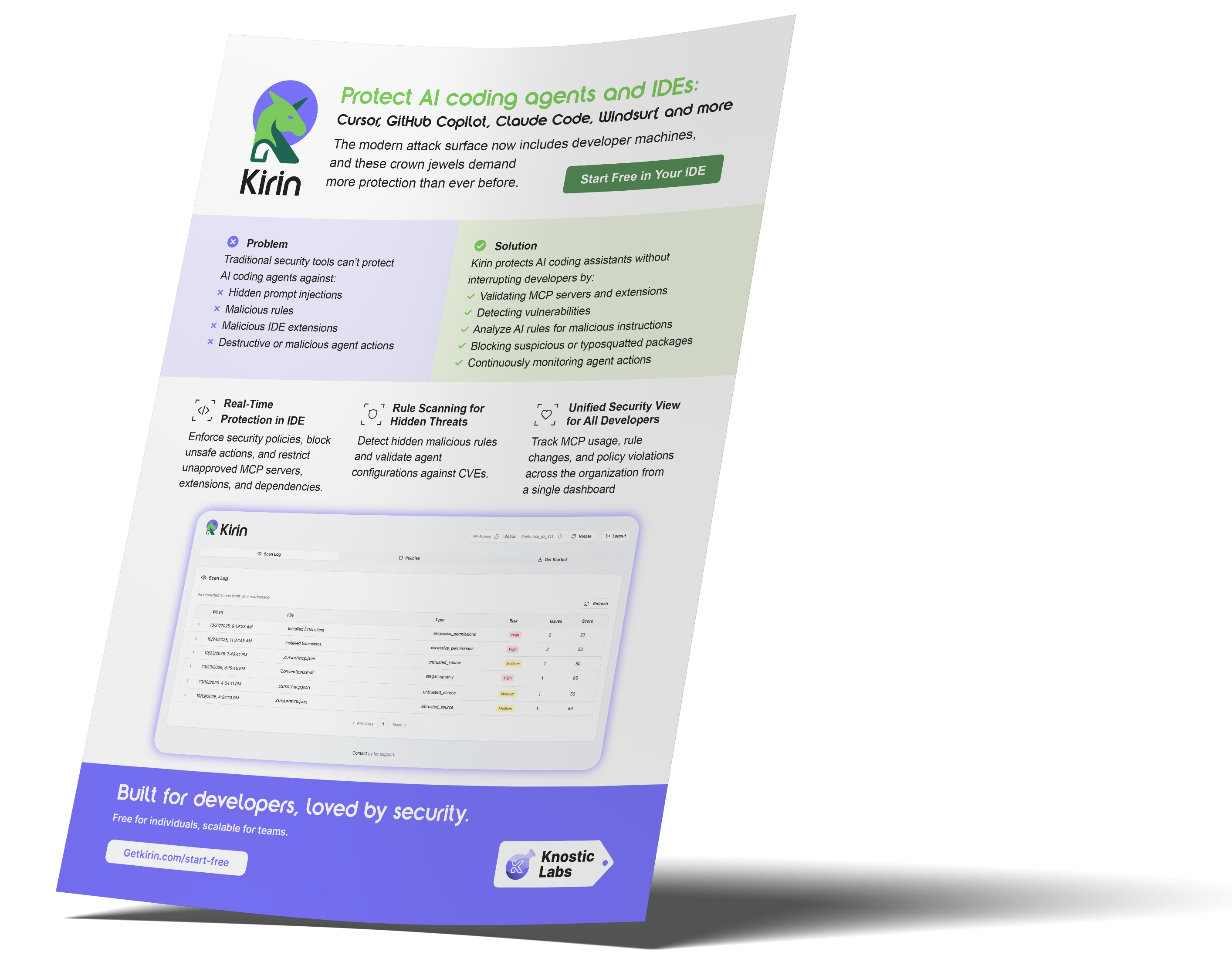
Kirin by Knostic Labs addresses this risk by controlling exactly what the agent can read, write, or execute within the IDE. By securing the interface between the developer, the project, and the agent, Kirin reduces credential sprawl at its source.
FAQ
- Why do AI coding agents cause credential sprawl in the first place?
AI coding agents automatically ingest configuration files, environment variables, and logs that often contain multiple tokens, resulting in a rapid accumulation of overlapping credentials. As these keys spread across tools, plugins, and MCP servers, teams lose visibility, increasing the chance of misuse.
- How can teams rotate credentials safely when AI agents rely on them?
Teams can rotate credentials safely by using short-lived tokens and pulling them dynamically from vault systems rather than storing them in local files. Event-based rotation and monitoring ensure that stale or suspicious tokens are replaced before they can be exploited.
- How does Kirin help manage and protect credentials used by AI coding agents?
Kirin prevents agents from ingesting unnecessary secrets by redacting sensitive values and enforcing strict access boundaries inside the IDE. It also monitors agent behavior and blocks unsafe actions, reducing the risk that cloud or API tokens are exposed or misused.
Subscribe to our blog!
Data Leakage Detection and Response for Enterprise AI Search
Learn how to assess and remediate LLM data exposure via Copilot, Glean and other AI Chatbots with Knostic.


The Data Governance Gap in Enterprise AI
See why traditional controls fall short for LLMs, and learn how to build policies that keep AI compliant and secure.

Rethinking Cyber Defense for the Age of AI
Learn how Sounil Yu’s Cyber Defense Matrix helps teams map new AI risks, controls, and readiness strategies for modern enterprises.

Extend Microsoft Purview for AI Readiness
See how Knostic strengthens Purview by detecting overshared data, enforcing need-to-know access, and locking down AI-driven exposure.

Build Trust and Security into Enterprise AI
Explore how Knostic aligns with Gartner’s AI TRiSM framework to manage trust, risk, and security across AI deployments.

Real Prompts. Real Risks. Real Lessons.
A creative look at real-world prompt interactions that reveal how sensitive data can slip through AI conversations.

Stop AI Data Leaks Before They Spread
Learn how Knostic detects and remediates oversharing across copilots and search tools, protecting sensitive data in real time.
Accelerate Copilot Rollouts with Confidence
Equip your clients to adopt Copilot faster with Knostic's AI security layer, boosting trust, compliance, and ROI.

Reveal Oversharing Before It Becomes a Breach
See how Knostic detects sensitive data exposure across copilots and search, before compliance and privacy risks emerge.

Unlock AI Productivity Without Losing Control
Learn how Knostic helps teams harness AI assistants while keeping sensitive and regulated data protected.
Balancing Innovation and Risk in AI Adoption
A research-driven overview of LLM use cases and the security, privacy, and governance gaps enterprises must address.

Secure Your AI Coding Environment
Discover how Kirin prevents unsafe extensions, misconfigured IDE servers, and risky agent behavior from disrupting your business.