




Somewhere between hype decks and regulatory memos, "AI safety" and "AI security" started getting used as if they meant the same thing. They do not.
For security leaders, that confusion is expensive. If you blur the line between safety and security, you blur who owns which risks, what kinds of failure you are defending against, and how you decide when an AI system is ready for production.
Words matter, so it’s worth getting precise.
For the full context (and a lively debate on where AI safety and security truly diverge) watch the episode embedded below before continuing.
Working Definitions: AI Safety vs. AI Security
A simple question separates safety from security: what happens when the system behaves exactly as designed?
If the system is functioning as intended and still produces harmful outcomes, you have a safety problem. If the system is being pushed off its intended track by an attacker, you have a security problem.
AI safety is about the consequences of a "correctly" functioning system. The model is not being hacked, it is doing what it was allowed to do. The real questions are whether its goals are aligned with human and organizational intent, whether you are comfortable with the decisions it is empowered to make, and whose lives, rights, or opportunities it meaningfully affects once deployed.
This is the territory of bias, discrimination, self harm scenarios, manipulative behavior, and broader societal impact.
AI security is about adversaries. It covers attempts to subvert, steal, or weaponize your AI stack using prompt injection, data poisoning, compromised coding assistants, malicious MCP servers, and traditional infrastructure attacks. A secure system is not automatically safe. It is simply harder for an attacker to bend it to their purpose.
You can easily imagine an AI system that is highly secure yet deeply unsafe: locked down against intrusion, but reliably pursuing a harmful objective. You can also imagine one that is safe in principle but fragile in practice, with thoughtful guidelines wrapped around trivially exploitable guardrails. In the real world, you do not get to choose one or the other. You need both.
Safety, Security, and Privacy: Untangling the Triad
The picture gets more complicated when we add privacy, because all three concerns overlap.
Privacy is mostly about what is known, which data is collected, inferred, stored, and revealed. It maps cleanly to confidentiality.
Security broadens that to the full CIA triad. It asks who can read, alter, or disrupt systems and data. Model theft, poisoning, prompt injection, and abuses of tools or agents sit here.
Safety sits slightly above both. Suppose your privacy controls are in place, your security stack is green, and your models are doing exactly what they were built to do. The safety question is whether the downstream effects are acceptable. Are people being harmed or unfairly disadvantaged by a system that passed every technical test?
There is a useful asymmetry here. Privacy by design can reduce the security burden, because data you never collect cannot be exfiltrated. Safety by design can limit the conditions under which a security failure becomes catastrophic. But hardening cannot rescue a harmful objective. A misaligned system that is perfectly defended is simply very reliable at doing the wrong thing.
Governance: Who Owns AI Safety vs. AI Security?
Once you treat safety and security as distinct domains, you immediately run into a governance problem.
In many enterprises, security leaders assume they own anything labeled "AI security." Privacy and legal teams gravitate toward "AI safety," because that is where liability and regulatory exposure live. Product and data leaders continue to build and ship AI capabilities because the business demands it, often without a clear mandate from either group.
That creates a fuzzy RACI chart and a lot of meetings that never quite resolve ownership.
The emerging Chief AI Officer role is one attempt to untangle this, by giving a single executive the mandate to coordinate AI initiatives across security, safety, privacy, and product. In practice, however, budgets, teams, and metrics are still organized in traditional silos.
Until that matures, it helps to make one distinction explicit inside your organization: safety is about what the AI is allowed to do, and to whom. Security is about how hard it is to bend that system off its intended path. Governance is the mechanism that decides who is allowed to change those answers. If you struggle to write down a single accountable name for each of those, you have an AI governance problem, not just an AI technology problem.
Safety Engineering vs Security Engineering for AI
Safety and security diverge not only in what they care about, but in how they reason.
Safety engineering assumes accidents. It asks, given normal use, under what conditions this system might fail in a way that harms someone. It is probabilistic and scenario driven, with decades of practice in aviation, medicine, and industrial control.
Security engineering assumes adversaries. It asks what a determined attacker could do to break, subvert, or repurpose the system, and how to make that path prohibitively difficult. It is less about probability and more about imagination, cost, and asymmetry.
AI strains both disciplines. For safety, we are dealing with systems that are non deterministic, opaque, and compositional. A model that appears aligned in a controlled environment can behave very differently when embedded in complex workflows and social contexts.
For security, the attack surface now includes prompts, tools, training data, coding assistants, MCP servers, IDE extensions, and informal glue logic in scripts and workflows. The boundary between a benign input and a weaponized instruction is thin and difficult to formalize. It is not surprising that AI risk conversations often feel slippery: we are asking safety questions about systems that look like security problems, and security questions about systems that manifest as safety failures.
Practical Risks: Where Safety and Security Collide
The collision between safety and security is already visible in developer environments.
Coding assistants now sit inside IDEs with access to repositories, environment variables, and build tooling. MCP servers and extensions extend that reach into production like systems and SaaS platforms. A malicious extension, a compromised MCP server, or a carefully crafted prompt can cause an assistant to exfiltrate secrets, run destructive commands, or introduce subtle backdoors while appearing to perform routine refactoring.
Is that a safety issue or a security issue? In practice, it is both. You had a safety problem in how much trust and autonomy you granted the assistant, and a security problem in how trivial it was to hijack that trust. Together, these make a software supply chain that can be corrupted at machine speed.
As organizations experiment with more agentic systems, the distinction blurs further. Agents that can plan, call tools, consult other models, and iterate on their own outputs make it harder to separate "the system did what it was designed to do" from "someone learned how to steer it into doing their work."
Looking Ahead: What Should Make You Nervous (and What to Do About It)
The risks that should concern AI and security leaders most are not limited to speculative scenarios. They look more like this: agentic systems deployed into environments that still have uneven access control and segmentation, AI tools granted broad autonomy in developer and business workflows without a systematic analysis of failure modes, and an organizational habit of treating "AI security" as a narrow technical problem while "AI safety" is pushed into ethics decks and policy documents.
The way forward is not to build a parallel universe for AI, but to integrate these concerns into your existing governance. Define what AI safety and AI security mean in your context. Make accountability explicit. Bring AI systems into your existing disciplines for identity, logging, incident response, and vendor risk, rather than treating them as experimental outliers. And for any system that interacts with customers, employees, or the public, assess the harms it can cause even when no attacker is present.
The real difference between AI safety and AI security is not which team gets the budget. It is whether you treat AI as a marginal feature of existing systems or as a new class of actor whose behavior must be understood, constrained, and, when necessary, overruled. If you get that mental model right, the rest of the organization can catch up.
What’s Next?
As organizations push deeper into agentic AI, MCP ecosystems, and increasingly autonomous coding assistants, one thing is clear: the development environment has become part of the attack surface. The next wave of incidents won’t start in production. They’ll start in your IDE.
If you’re looking to get ahead of that shift, Kirin was built for precisely this moment. It gives teams the visibility and guardrails they need to defend against prompt injection, data poisoning, compromised assistants, and malicious MCP servers, before those risks land in your codebase.
See how Kirin helps teams build safely with AI: GetKirin.com
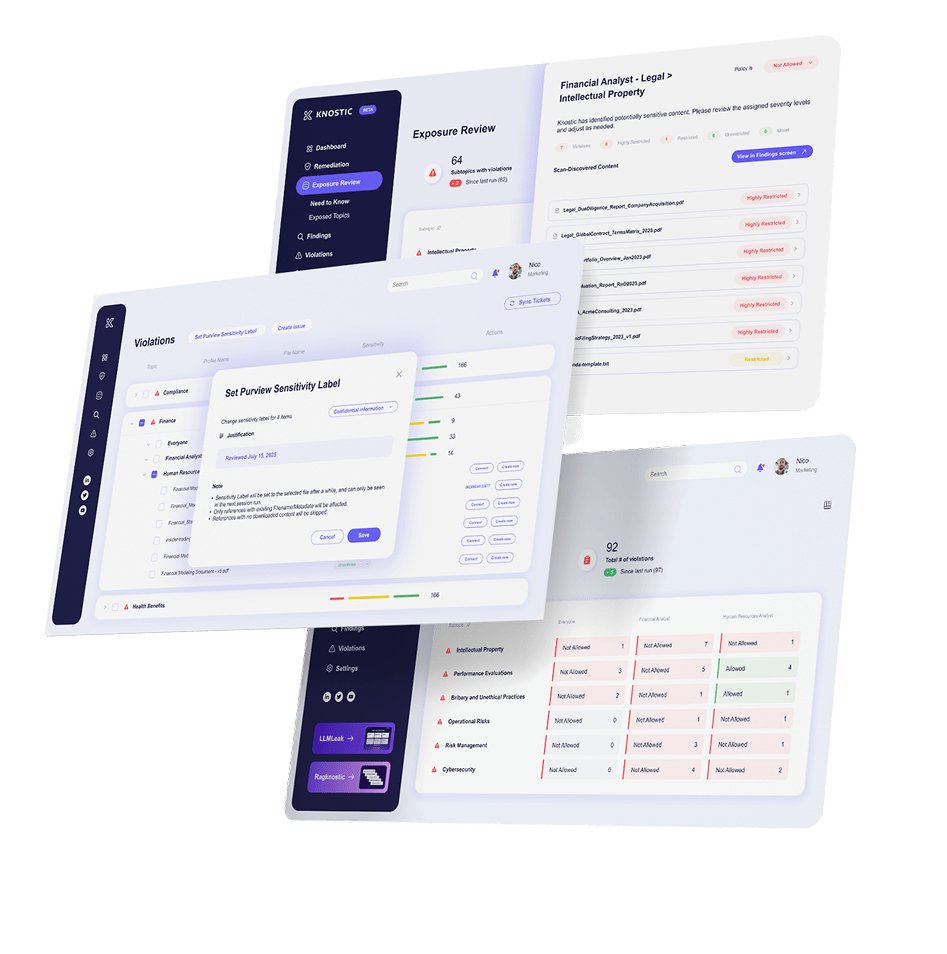
Data Leakage Detection and Response for Enterprise AI Search
Learn how to assess and remediate LLM data exposure via Copilot, Glean and other AI Chatbots with Knostic.


The Data Governance Gap in Enterprise AI
See why traditional controls fall short for LLMs, and learn how to build policies that keep AI compliant and secure.

Rethinking Cyber Defense for the Age of AI
Learn how Sounil Yu’s Cyber Defense Matrix helps teams map new AI risks, controls, and readiness strategies for modern enterprises.

Extend Microsoft Purview for AI Readiness
See how Knostic strengthens Purview by detecting overshared data, enforcing need-to-know access, and locking down AI-driven exposure.

Build Trust and Security into Enterprise AI
Explore how Knostic aligns with Gartner’s AI TRiSM framework to manage trust, risk, and security across AI deployments.

Real Prompts. Real Risks. Real Lessons.
A creative look at real-world prompt interactions that reveal how sensitive data can slip through AI conversations.

Stop AI Data Leaks Before They Spread
Learn how Knostic detects and remediates oversharing across copilots and search tools, protecting sensitive data in real time.
Accelerate Copilot Rollouts with Confidence
Equip your clients to adopt Copilot faster with Knostic's AI security layer, boosting trust, compliance, and ROI.

Reveal Oversharing Before It Becomes a Breach
See how Knostic detects sensitive data exposure across copilots and search, before compliance and privacy risks emerge.

Unlock AI Productivity Without Losing Control
Learn how Knostic helps teams harness AI assistants while keeping sensitive and regulated data protected.
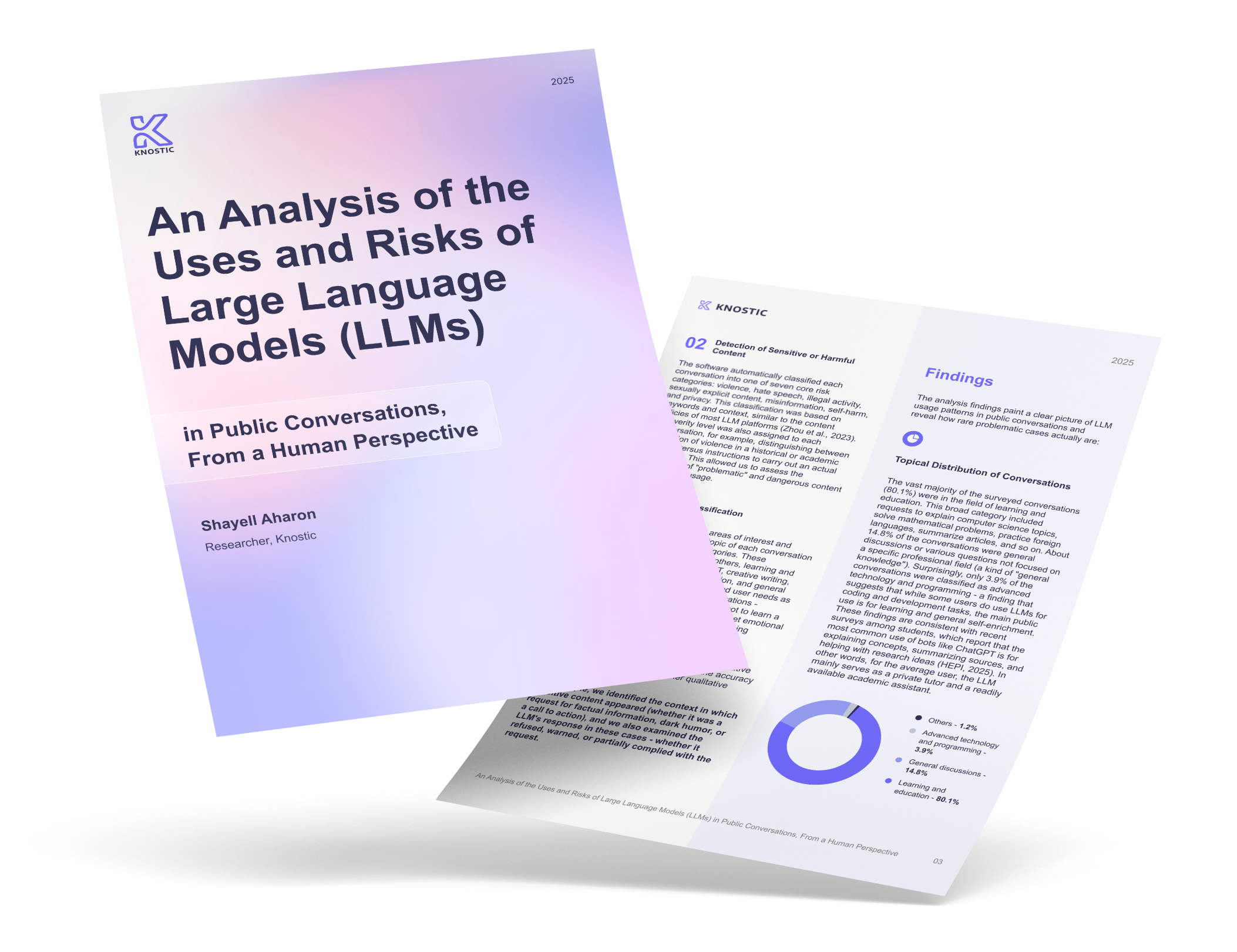
Balancing Innovation and Risk in AI Adoption
A research-driven overview of LLM use cases and the security, privacy, and governance gaps enterprises must address.

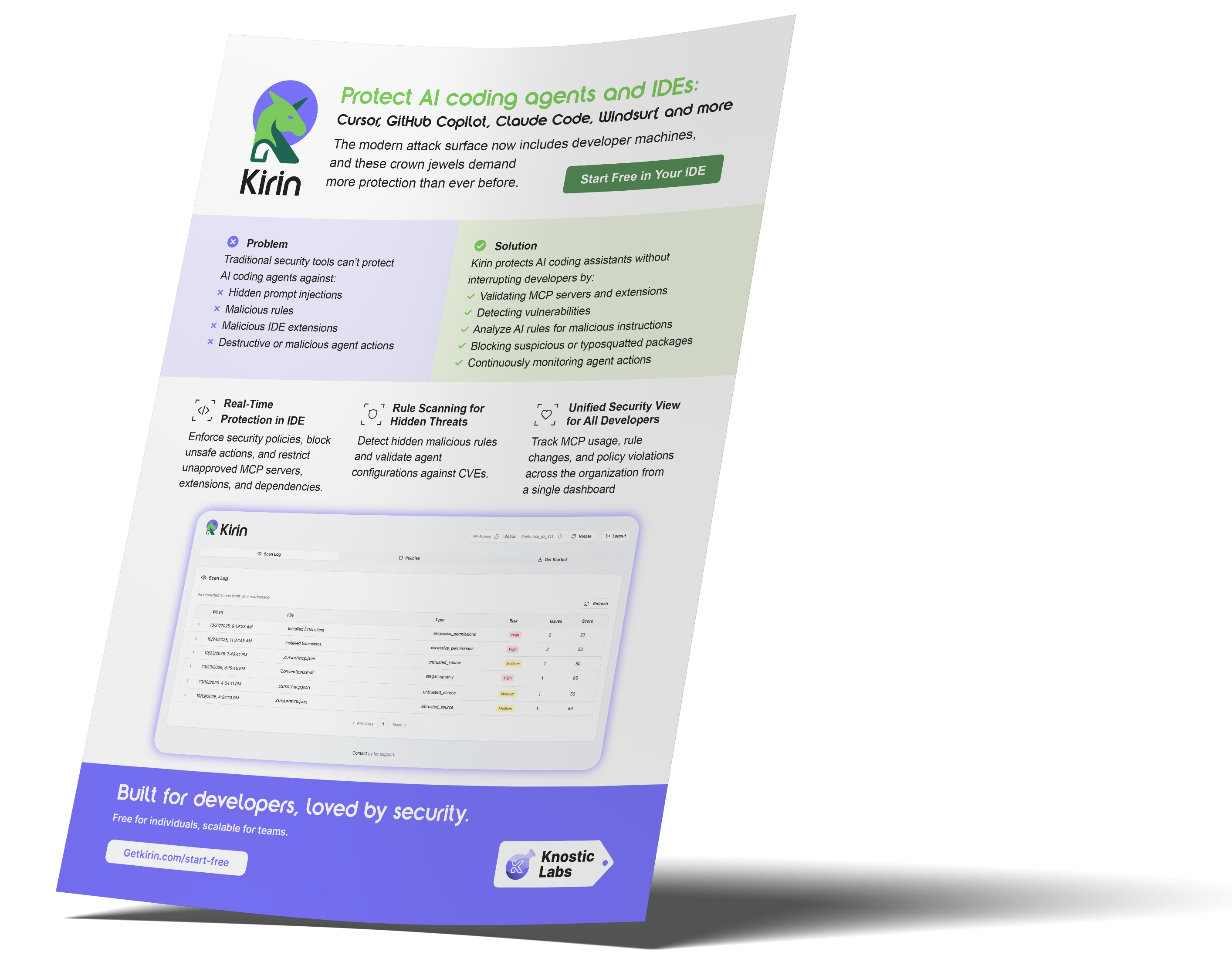
Secure Your AI Coding Environment
Discover how Kirin prevents unsafe extensions, misconfigured IDE servers, and risky agent behavior from disrupting your business.
Tags:
research findings