
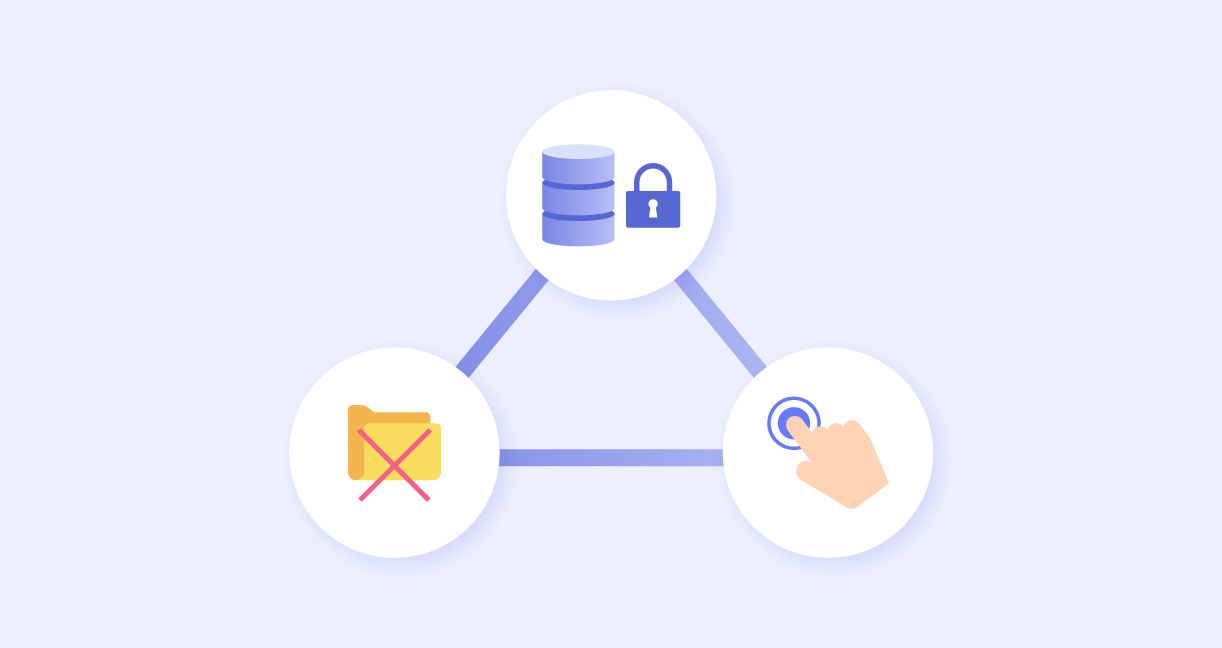


Key Findings on MCP Governance
-
MCP is a flexible standard that connects AI agents, IDEs, and developer tools to files, APIs, and services, streamlining access across workflows.
-
Model Context Protocol governance transforms a clever protocol into a compliant and enforceable access fabric for AI agents and IDEs.
-
A clear framework for policies, permissions, and oversight prevents “shadow AI automation,” where unsanctioned agents connect to tools and data outside enterprise control.
-
Strong MCP governance aligns security, DevSecOps, and platform engineering so that every MCP server, tool, and action is tied to identity, logged, and continuously monitored.
-
Unmanaged MCP configurations can quietly evolve into high-risk production infrastructure, making governance essential to prevent hidden automation and enforce policy-based accountability.
Understanding MCP Governance
The Model Context Protocol standardizes the connection between AI coding agents, IDEs, and applications, enabling the seamless integration of powerful capabilities directly into developer workflows. This open and flexible design is exactly why MCP governance now matters as much as the protocol itself.
Security protects against threats, but governance defines who may call which MCP servers, for what purpose, under which constraints, and with what accountability. When those decisions are left to local IDE settings or individual experimentation, organizations quietly accumulate “shadow AI automation”. This is a growing pattern where unsanctioned agents and extensions connect to tools and data outside approved visibility or governance, effectively creating unmanaged automation within the enterprise.
Recent data from McKinsey & Company’s global survey, The state of AI in 2025: Agents, innovation, and transformation indicate that 88% of organizations now utilize AI in at least one business function, with 23% already scaling agentic AI systems and 39% experimenting with them. This rapid integration means that an unmanaged MCP layer can quickly evolve into part of critical production infrastructure, introducing potential exposure and operational risk rather than remaining a harmless experiment.
The risk is not theoretical. Recent reports, including Shadow AI Prevention by CSA, show that a lack of AI agent access control is a recurring factor in AI-related security incidents and breaches, especially when unsanctioned tools are involved. In environments where genAI and agent adoption are already mainstream, an unmanaged MCP layer becomes a hidden control plane that can bypass traditional AppSec and identity guardrails. MCP governance closes that gap by turning every connection, permission set, and server into something explicit, owned, and testable.
Core Principles of MCP Governance
Effective MCP governance relies on a set of core principles that turn flexible access into controlled, auditable, and secure developer workflows.
Role-Based Access Control
Role-based access control (RBAC) for MCP begins with your real-world responsibilities, not with ad hoc IDE defaults. Permissions are grouped by role, team, and project so that front-end engineers, SREs, data scientists, and contractors do not share the same MCP capabilities. Sandbox environments receive broader, low-risk access to MCP, while production-facing roles operate under tightly constrained server lists and action scopes. This separation limits the blast radius when an agent misbehaves, a credential leaks, or a configuration is pushed with errors. RBAC for MCP should also distinguish between human identities and agent identities, ensuring that agent tokens never silently inherit full human privileges. Mapping roles to MCP scopes makes approvals auditable and simplifies onboarding and offboarding across many IDEs and repositories.
Trusted Server Registry
A trusted server registry is the single source of truth for which MCP servers are allowed in your environment. Instead of letting each developer paste arbitrary endpoints into their IDE, teams reference an approved catalog of internal and vetted external MCP services. Every entry in this registry includes ownership, purpose, data classification, and whether the server is permitted in sandbox, staging, or production. Digital signing and verification for MCP servers enhance this control, allowing clients to confirm they are interacting with an authentic and uncompromised endpoint before exposing secrets or executing actions. Registry updates follow a lightweight review workflow, allowing security and platform teams to evaluate new servers without blocking delivery.
Over time, this curated list becomes a governance asset that documents integration risk, acceptable use, and deprecation timelines. A clear registry also makes it easier for MCP configuration oversight layers to enforce “only talk to trusted MCP servers” directly inside IDEs and pipelines.
Policy as Code
Operational hardening aligns with MCP security baselines. Policy as code turns MCP governance from static policy documentation into something testable and enforceable. Open-source patterns such as the Open Policy Agent (OPA) framework or Rego-based GitHub actions demonstrate how policy-as-code principles can be extended to MCP environments for pre-merge validation and runtime enforcement. Governance rules that describe which roles can access which MCP servers, along with the methods and rate limits, are maintained in version-controlled repositories alongside infrastructure definitions. This approach enables code review, change history, and automated checks before any MCP configuration goes live.
Auditing and Accountability
Auditing for MCP means recording every meaningful interaction in a way that clearly attributes actions to both a human user and any involved agent identity. Connection events, requested methods, resource scopes, and key responses should be logged with sufficient detail to reconstruct who performed what action, through which MCP server, and at what time. These logs support investigations when suspicious automation is detected, and they provide regulatory and customer evidence when you need to demonstrate proper control.
Comprehensive auditing also aligns with compliance requirements under frameworks such as GDPR (Articles 5 and 30), ISO/IEC 27001, and the emerging ISO/IEC 42001 standard for AI management systems, which all require demonstrable traceability of automated actions. When auditing is complete and consistent, MCP governance shifts from reactive forensics to proactive assurance.
Continuous Monitoring
Continuous monitoring makes MCP governance dynamic instead of static. Telemetry from IDEs, MCP servers, gateways, and agent frameworks is streamed into monitoring and SIEM platforms to watch for unusual patterns. Unexpected connections to unregistered servers, sudden spikes in sensitive method calls, or repeated authorization failures act as early indicators of misconfiguration or malicious use. Alert rules can distinguish between routine experimentation in sandbox spaces and suspicious attempts to route production data through unknown endpoints. Close integration with DevSecOps tooling allows automated responses such as blocking a rogue configuration, revoking a token, or forcing policy resynchronization. AI monitoring dashboards provide appsec, platform, and security operations with a shared, real-time view of MCP health and compliance posture. With this feedback loop, governance is continuously validated instead of assumed.
5 Common Governance Challenges with MCP
Common MCP governance challenges stem from poor visibility, inconsistent permissions, fragmented configurations, weak auditing, and policy drift. Each of these undermines control and accountability across rapidly expanding AI and developer environments.
1. Lack of Visibility: Who’s Using Which MCP Servers and for What Purpose?
Many teams begin experimenting with MCP within their IDEs without registering endpoints or documenting the reasons for their additions. Over time, this creates a hidden mesh of connections to internal tools, SaaS APIs, and custom services that leadership cannot fully see or assess. When an incident occurs, responders struggle to answer basic questions about which agents and users touched which systems via MCP. This blindness also makes it hard to align usage with legal, privacy, or data residency rules because there is no reliable inventory.
A structured discovery effort that scans configs, repositories, and workspace settings is often required to build the first complete view. Once visibility improves, teams can classify MCP servers by sensitivity and align them with appropriate controls. Without that baseline, every new MCP feature increases uncertainty instead of value.
2. Inconsistent Permission Models: No Precise Mapping of Tool Access to Developer Roles
When MCP permissions are configured on a per-user or per-workspace basis, access decisions become complex and multifaceted. Developers copy configurations between projects, agents inherit excessive scopes, and temporary debug access quietly becomes permanent. These patterns conflict with least-privilege principles, making it challenging for auditors to establish a clear link between job role and allowed system actions. Inconsistent models also frustrate engineers who encounter unexpected failures or over-blocking, as each environment behaves differently.
Centralized RBAC definitions for MCP, aligned with identity providers, can repair this fragmentation by standardizing who can reach which servers and operations. With a shared MCP permission management model, it becomes feasible to conduct regular reviews, identify outliers, and maintain privileges aligned with actual work. Organizations that delay this step often find remediation painful once MCP usage becomes widespread.
3. Decentralized Configuration Management: MCP Settings Vary Across IDEs and Repos
If each team manages MCP settings manually within local IDE configurations, dotfiles, or scattered YAML files, control quickly dissolves. Different branches may reference different MCP servers for the same workflow, some pointing to test instances, others to production, and a few to endpoints no one remembers owning. This inconsistency introduces subtle reliability and security issues that are hard to debug, especially in distributed teams.
Treating MCP configurations as managed artifacts, stored centrally and referenced by developers, reduces this entropy. Platform teams can publish versioned configuration bundles that define approved servers, policies, and scopes for each environment. Integration with configuration management and CI/CD gives a clear path for proposing, reviewing, and rolling out changes. Without this structure, MCP governance relies on every individual remembering to “do the right thing” in their personal setup, which is unsustainable.
4. Missing Audit Trails: Inability to Trace Agent or Plugin Actions
MCP-backed agents often feel invisible to traditional logging stacks if their calls are not explicitly captured. When logs exist only on local machines or inside isolated plugins, investigations hit dead ends, and compliance teams lack defensible records. The absence of end-to-end traces also weakens trust in AI-powered automation, as leaders cannot see how decisions were made or which systems were involved.
To address this, organizations route MCP events to centralized logging, where entries are tied together by human identity, agent identity, endpoint, and action. Normalizing these records makes correlation easier across microservices, CI jobs, and developer tools. Regulatory frameworks and emerging AI governance standards are increasingly expecting this level of traceability for high-impact systems. Where audit trails remain patchy, MCP governance cannot credibly claim control.
5. Policy Drift: Configurations Evolve Faster than Review Cycles, Breaking Compliance
MCP configurations change as teams add new tools, iterate on workflows, or adopt fresh AI capabilities. When governance reviews lag behind these adjustments, actual behavior diverges from documented policy. This “policy drift” can expose sensitive datasets, violate regional data rules, or contradict contractual promises to customers.
Automated validation of MCP configurations against policy-as-code rules helps catch drift early, rather than during yearly audits. Regular comparison of trusted server registries, RBAC mappings, and observed connections shows where exceptions have accumulated. Incorporating feedback from security findings and incidents ensures that the policy set evolves in line with real-world usage, rather than against it. By tightening this loop, MCP governance stays aligned with both engineering reality and compliance expectations.
MCP Governance Policy Checklist
A clear MCP governance checklist turns good intentions into enforceable controls. Every MCP integration should be validated before any agent or IDE can use it. Focus on server trust, scoped access, full traceability, and rapid feedback loops when policies change. Treat MCP endpoints like production APIs, not personal plugins. Apply the same rigor to CI/CD, secrets, and SSO that you do to other areas.
Use the following pre-deployment gate as a hard requirement, not a suggestion:
-
All MCP servers are verified, owned, and cryptographically signed where supported.
-
Access is scoped by team and role, never left to individual IDE defaults or personal server lists.
-
Logs capture every MCP server handshake, request, and high-impact command in a central location.
-
Policy updates trigger mandatory reviews, automated validation, and targeted notifications to affected teams.
-
Continuous scans and config discovery jobs detect unapproved MCP endpoints or drifted settings across workspaces.
Best Practices for MCP Governance
As AI and agents scale, organizations should embed the following practices early to avoid expensive retrofits and reduce both operational noise and audit friction:
-
Start from a single, authoritative registry for all allowed MCP servers and configurations.
-
Publish centrally managed MCP profiles so teams use approved settings instead of inventing their own.
-
Replace manual one-off approvals with automated enforcement in CI/CD and IDE plugins that block unregistered or mis-scoped MCP endpoints.
-
Standardize policy-as-code templates so RBAC mappings, logging rules, and data-handling constraints look identical across repositories and business units.
-
Expose governance dashboards that display which teams utilize which MCP servers, along with their respective permissions, and where alerts are being triggered.
-
Schedule recurring reviews that align registry entries, policies, and observed usage, and close exceptions quickly.
Governance teams should formalize these practices into a downloadable internal checklist or governance strategy template, allowing MCP verification steps to be reused across projects. Platforms such as the NIST Open Security Checklist Repository provide reliable models for converting verification lists into standardized audit assets. Scaling proceeds through the MCP deployment stages and metrics.
Strengthen MCP Governance with Kirin
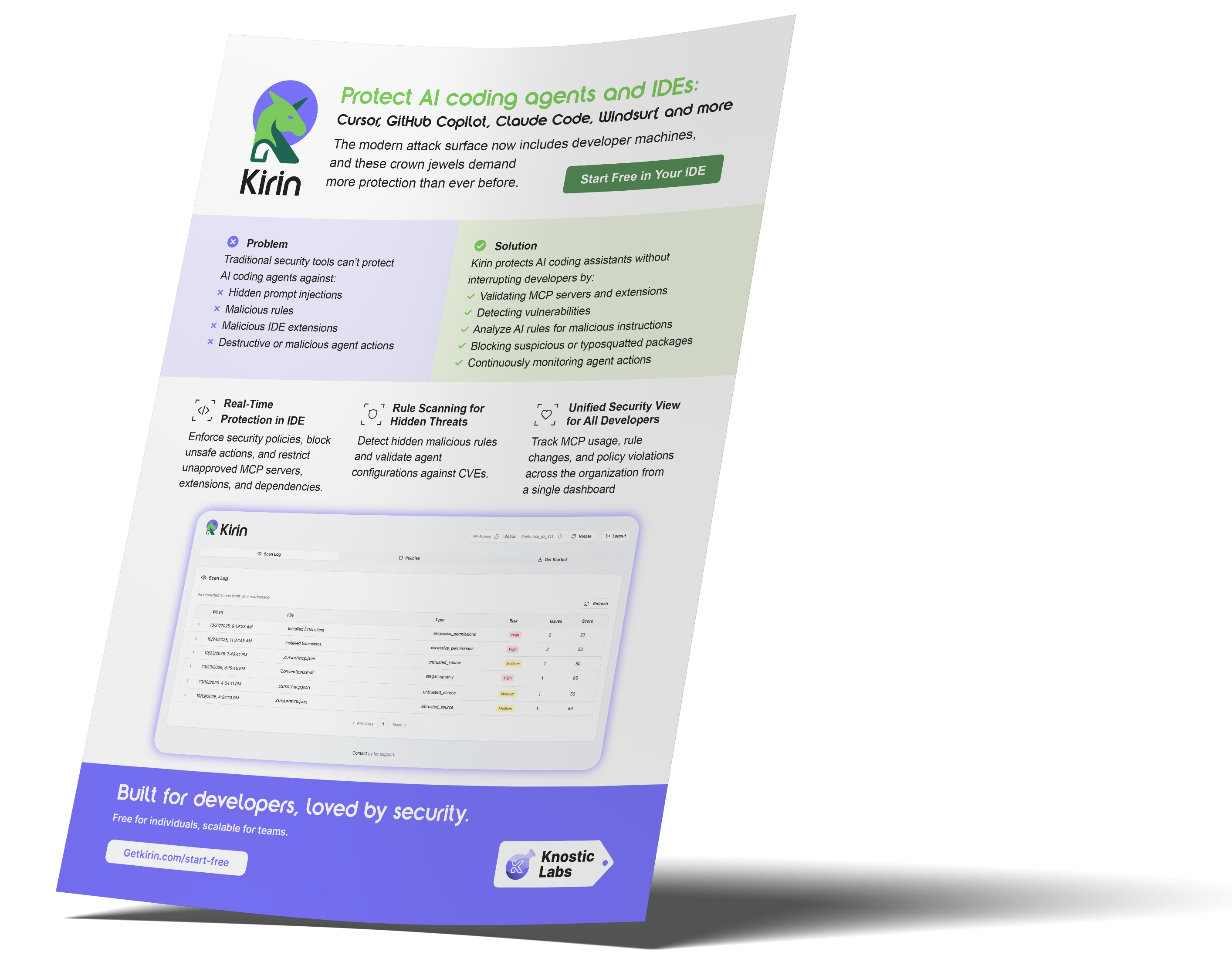
Traditional governance tools often focus on identity or network access but miss the ‘last-mile’ integrations between IDEs, AI agents, and MCP servers. Kirin bridges that gap by enabling use-case-specific visibility and enforcement across the MCP layer, helping teams govern connections, actions, and agents rather than just users.
Here are three key capability gaps Kirin addresses compared to legacy controls:
-
Unmonitored MCP server connections: Many tools track human login events but do not validate whether an AI agent or IDE plugin is connecting to an approved MCP server. Kirin automatically validates every MCP endpoint in real time.
-
Agent-action attribution: Traditional IAM logs record user activity but rarely distinguish between human and agent identities. Kirin captures and attributes actions by both agents and users, allowing for the auditing of every command, plugin, or server access.
-
Configuration drift detection inside developer tools: Most governance frameworks oversee infrastructure and apps, not IDEs and agent boilers. Kirin detects misconfigurations and drift in MCP servers, extensions, and agent settings as changes happen.
Ensure governance, not just security, with Kirin features as the enforcement and visibility layer for your MCP ecosystem.
FAQ
-
What is MCP governance, and why is it important?
MCP governance is the framework that defines who can use which MCP servers, for what purpose, under what constraints, and with what auditing. It is critical because MCP acts as a control plane for AI agents and IDEs, so unmanaged access quickly turns into shadow automation, compliance exposure, and untraceable changes.
-
How does MCP governance differ from MCP security?
MCP security protects endpoints and data, while MCP governance determines which roles, agents, and environments are permitted to utilize those endpoints and under what policies. In practice, security is about protection mechanisms, and governance is about ownership, permissions, approvals, and accountability around those mechanisms.
-
How can tools like Kirin improve MCP governance and oversight?
Tools like Kirin enforce MCP policies directly in IDEs and agent workflows by validating servers, scopes, and configurations at the point of use. They also provide centralized visibility and attribution for MCP activity, turning governance rules into real-time, provable controls.
Subscribe to our blog!

Data Leakage Detection and Response for Enterprise AI Search
Learn how to assess and remediate LLM data exposure via Copilot, Glean and other AI Chatbots with Knostic.


The Data Governance Gap in Enterprise AI
See why traditional controls fall short for LLMs, and learn how to build policies that keep AI compliant and secure.

Rethinking Cyber Defense for the Age of AI
Learn how Sounil Yu’s Cyber Defense Matrix helps teams map new AI risks, controls, and readiness strategies for modern enterprises.

Extend Microsoft Purview for AI Readiness
See how Knostic strengthens Purview by detecting overshared data, enforcing need-to-know access, and locking down AI-driven exposure.

Build Trust and Security into Enterprise AI
Explore how Knostic aligns with Gartner’s AI TRiSM framework to manage trust, risk, and security across AI deployments.

Real Prompts. Real Risks. Real Lessons.
A creative look at real-world prompt interactions that reveal how sensitive data can slip through AI conversations.

Stop AI Data Leaks Before They Spread
Learn how Knostic detects and remediates oversharing across copilots and search tools, protecting sensitive data in real time.
Accelerate Copilot Rollouts with Confidence
Equip your clients to adopt Copilot faster with Knostic's AI security layer, boosting trust, compliance, and ROI.

Reveal Oversharing Before It Becomes a Breach
See how Knostic detects sensitive data exposure across copilots and search, before compliance and privacy risks emerge.

Unlock AI Productivity Without Losing Control
Learn how Knostic helps teams harness AI assistants while keeping sensitive and regulated data protected.

Balancing Innovation and Risk in AI Adoption
A research-driven overview of LLM use cases and the security, privacy, and governance gaps enterprises must address.

Secure Your AI Coding Environment
Discover how Kirin prevents unsafe extensions, misconfigured IDE servers, and risky agent behavior from disrupting your business.