


What This Blog Post on Cursor Covers
-
Cursor is a predictive engine, not a policy enforcer, so it often ignores rules in favor of generating plausible code, leading to frequent violations of security and compliance standards.
-
Prompt instructions lose effectiveness over time due to token-based context handling, making it easy for later inputs to override critically important rules without user awareness.
-
There is no built-in policy engine in Cursor. So, rules such as avoiding secrets or enforcing sanitization are treated as optional and not enforced during code generation.
-
AI coding tools can take unintended actions, including modifying file systems or installing unsafe dependencies, increasing the need for external runtime governance.
Why Cursor and AI Coding Tools Ignore Rules
The AI coding tool Cursor doesn't follow rules because it is fundamentally a prediction engine rather than a policy enforcer. This architectural limitation is central to Cursor's security concerns because prediction-driven behavior cannot enforce enterprise security or compliance requirements deterministically. These models are trained to generate plausible code based on patterns in training data, rather than guarantee compliance with internal policies. This leads to predictable rule erosion when complexity grows. The issue is structural, not just configuration-based. That’s why simple prompt changes often do not fix it in the long term.
Security teams and DevSecOps leads must understand these limitations to govern AI-generated code effectively. These gaps matter because insecure AI output is common. Research shows up to 45% of AI-generated code introduces security flaws, even when developers aim to enforce standards.
Prompt Priority and Context Overload
When developers send a series of instructions to Cursor, the model does not treat them as a strict hierarchy. Instead, the model uses token-based context and often prioritizes the most recent or salient text. This behavior explains why Cursor AI ignores instructions that were provided earlier in a session, even when those instructions define critical security or compliance requirements. This leads to later inputs unintentionally overriding earlier rules. Large or conflicting prompt contexts dilute earlier instructions, leading the model to generate outputs that violate security or compliance rules defined at the start of a session.
This “context erosion” is not a bug; it is a consequence of how current large language models process sequences. Such structural behavior enables context-window manipulation attacks, in which short or strategically placed instructions override earlier security constraints without the user's awareness.
No True Policy Engine
Cursor and similar AI coding tools lack a real policy engine. Rules provided via prompts are suggestions to the model, not enforceable constraints. There is no system to block output that violates a rule. Even when Cursor acknowledges a guideline in natural language, it can still produce insecure or non-compliant code because the model’s internal objective is to generate the most statistically plausible continuation, not to uphold static policies. This means rules like “never include hardcoded credentials,” or “enforce input sanitization” can be lost in translation. Without an external policy decision point, rules degrade into best-effort guidance. Effective governance requires controls outside the model that can deterministically accept, reject, or transform AI outputs before they enter the codebase.
Tool-Calling and Autonomy
Cursor’s growing autonomy, such as interacting directly with the file system or enforcing refactors, means it can take actions beyond the explicit intent of the user’s prompt. When AI agents execute tasks autonomously, they optimize for completion rather than compliance. This risk becomes more severe when browser-level or tool-level integrations are involved. This is demonstrated by Model Context Protocol (MCP)-style hijacking techniques that allow external control paths to influence Cursor’s autonomous actions.
Cursor’s autonomy creates a governance gap because there are no runtime checkpoints to verify that actions align with enterprise policies. AI actions can include installing dependencies, altering security configurations, or generating code with unsafe defaults without explicit confirmation. This exposure is amplified when it operates through embedded browsing or execution surfaces, as documented cases show, where the Cursor browser was hijacked via MCP to execute actions outside the intended user's control.
Training vs Runtime Reality
AI models are trained on historical code to maximize completeness and relevance, not to enforce enterprise security standards. Policies and rules supplied after training cannot alter how a model reasons internally. While Cursor’s underlying model may “know” advantageous practices in principle, at runtime it still optimizes continuity and usefulness. This mismatch, often described in AI governance literature as a model alignment gap, means that secure patterns are frequently deprioritized when generative objectives conflict with rules.
Lack of Identity and Data Context
Cursor does not natively enforce identity, role, or sensitivity context when generating code. The model treats every request similarly, regardless of whether the user is an intern, a platform engineer, or a DevSecOps lead. Without binding policies to identity and environment context, the model has no way to determine if a user should have access to sensitive production systems or just test environments. This lack of identity-aware enforcement increases the likelihood that sensitive data, credentials, or policy violations appear in outputs. Organizations without context-aware governance experience higher rates of insecure AI output because the model lacks the data needed to calibrate outputs for risk and policy compliance.
Examples of Cursor Not Following Rules
Cursor’s rule violations are not hypothetical. They appear in practical workflows and pose measurable risks. These issues arise repeatedly because AI models aim to complete tasks that appear coherent rather than compliant. Governance gaps surface across security, licensing, dependency usage, and developer guidance.
Ignoring Secure Coding Guidelines
Cursor often omits basic secure coding practices when generating functional code. Code may lack proper input validation, error handling, or defense-in-depth measures because the model prioritizes flowing, readable output over defensive constructs. Even when prompts explicitly request security patterns, results often fall short. This occurs because Cursor’s focus is on output plausibility rather than policy adherence.
Generating Code with Secrets or Unsafe Defaults
AI coding tools frequently generate code that contains unsafe defaults, such as permissive configurations, weak authentication schemes, or accidentally embedded secrets. These outputs often result from the model mimicking common patterns found in training data, which may not reflect enterprise-grade hardening. Statistics quoted by Secondtalent in October 2025 suggest that many AI-generated APIs use insecure authentication methods and expose interfaces, thereby compounding risk.
Violating License or IP Constraints
Cursor does not verify software licenses or intellectual property constraints when generating code. It can reproduce patterns that resemble licensed or proprietary code because it does not assess the legal compatibility of outputs. This risk is material for enterprise compliance, especially when code is shipped into product environments. Governance systems must therefore include external checks for license compatibility and provenance tracking, as Cursor alone lacks a built-in mechanism to enforce these requirements.
Bypassing “Do Not Use” Libraries
Even when developers specify prohibited libraries, Cursor sometimes suggests them because the model is more likely to surface popular or statistically common code patterns. This is especially problematic when enterprise policies ban specific dependencies for security or architectural reasons. The model cannot treat such bans as hard constraints; instead, it treats them as soft preferences that can be overridden by competing signals within the prompt context.
Why This Becomes a Security and Governance Risk
Unchecked rule violations by Cursor and similar tools create systemic security and governance risks. These behaviors collectively represent Cursor AI security risks because ungoverned, non-deterministic code generation directly undermines enterprise security, compliance, and auditability. AI coding assistants' security concerns emerge when AI-generated code enters production, expands the attack surface, and erodes enterprise policy enforcement.
Enterprise research confirms that these governance risks are already widespread rather than emerging edge cases. For example, a 2025 Gartner survey of 360 IT leaders involved in the rollout of generative AI tools found that over 70% identified regulatory compliance and governance as one of their top three challenges when deploying GenAI productivity assistants. Despite this, only 23% of respondents reported being very confident in their organization’s ability to manage security and governance components for GenAI deployments.
Code Supply Chain Exposure
AI-generated code becomes part of the supply chain as soon as it enters shared repositories. Vulnerabilities in AI outputs propagate downstream and can bypass traditional static analysis if they fit standard syntactic patterns. As AI tools increasingly account for a growing share of code bases, this amplifies supply chain risk.
Data Leakage via Prompts and Outputs
Prompt history often contains contextual information, and AI outputs may echo sensitive tokens or logic from that context. Without controls, this leakage persists in logs or repository histories. Enterprise data governance policies cannot track or redact these exposures unless enforced outside the model itself.
Non-Compliance with Internal Policies
Cursor’s outputs frequently conflict with internal policies, including allowed configurations, dependency rules, and security guidelines. These gaps manifest as recurring Cursor compliance issues, where AI-generated code violates internal standards, regulatory requirements, or audit expectations without any deterministic enforcement or traceability. When AI assistants are treated as trusted coding partners, violations slip past human reviewers who assume compliance. This creates audit gaps and increases remediation costs.
No Audit Trail for “Why This Code Was Generated”
Cursor does not record an explicit audit trail that explains why it generated a specific snippet. This lack of traceability makes it difficult for security and compliance teams to justify decisions during audits or incident investigations. Regulators and enterprise frameworks increasingly emphasize explainability and traceability, which these tools do not provide natively.
Shadow AI in Developer Environments
Without governance, developers adopt AI assistants independently, creating shadow usage that security teams cannot inventory or monitor. This unmanaged adoption pattern is commonly referred to as shadow AI coding, where developers use AI assistants outside approved governance, visibility, and control frameworks. Surveys show that a large percentage of organizations use AI coding tools without adequate policies, leaving usage unguided and risky.
How Enterprises Should Govern Cursor and AI Coding Tools
Enterprises must stop treating AI coding tools as developer conveniences and start treating them as governed production systems. For organizations already using established governance guardrails, AI coding governance should be viewed as an extension rather than a replacement of existing controls. However, these controls typically operate after code is written, committed, or built. AI-assisted development introduces risk earlier in the lifecycle, when code is generated. Governing AI coding tools, therefore, requires upstream enforcement that complements SBOM analysis, policy evaluation, and dependency scanning, ensuring unsafe or non-compliant code is intercepted before it enters traditional pipelines.
Define “Allowed vs Disallowed” at the Policy Level
The first step in governing Cursor is defining what is explicitly allowed and disallowed at the policy level. These policies must cover libraries, frameworks, coding patterns, data handling, and licensing constraints. Policies should be written in enforceable terms, not advisory language. Vague guidance, such as “avoid secrets,” is insufficient. Policies must specify what constitutes a violation and what action should be taken when it occurs. This separation is essential because AI models cannot reliably infer policy intent. Knostic frames this requirement clearly in its guidance on AI coding assistant governance, which explains why policies must exist independently of prompts.
Monitor Coding Assistant Usage in Real Time
Enterprises must monitor how Cursor is actually used, not how they assume it is used. Real-time visibility is required to understand which repositories, environments, and developers are relying on AI assistance. Without monitoring, violations surface only after code review or incident response. This lag increases remediation cost and exposure. Monitoring also enables the detection of misuse patterns, such as repeated generation of insecure constructs. Industry surveys show that organizations lack visibility into AI-assisted coding in over 60% of development environments, creating blind spots in risk management. Continuous monitoring transforms AI usage from shadow activity into a managed capability.
Apply AI Usage Controls (AI-UC)
AI usage controls are the mechanism that translates policy into enforcement. AI-UC ensures that AI-generated code complies with organizational rules before it reaches developers or repositories. This control layer operates outside the model and does not rely on prompt obedience. AI-UC can block, redact, or modify outputs based on risk. This is important because models cannot consistently enforce constraints on their own. Gartner has reported that the lack of AI usage controls is a primary contributor to enterprise AI risk exposure through 2025. Applying AI-UC shifts governance from reactive review to proactive prevention.
Log and Audit All AI-Generated Code Decisions
Auditability is mandatory for regulated environments. Enterprises must be able to explain why a piece of AI-generated code was allowed or blocked. Cursor does not natively provide this decision trail. Without logs, compliance teams cannot satisfy audit or regulatory inquiries. Logging must include the policy evaluated, the decision outcome, and contextual factors such as the repository and role. This level of traceability is increasingly required under emerging AI governance frameworks. Organizations that lack AI audit logs face material compliance risk. Logging transforms AI coding from an opaque process into an accountable one.
Treat Coding Assistants as Production Systems
Cursor must be governed like any other production system. It interacts with production code, secrets, and infrastructure. Treating it as a “developer tool” understates its impact. Production systems require access controls, monitoring, enforcement, and change management. AI coding assistants meet all these criteria. When enterprises apply production-grade governance, AI usage becomes safer and more scalable. When they do not, risk compounds silently. Mature organizations already use this mindset for API gateways and CI/CD pipelines. AI coding assistants belong in the same category.
How Kirin by Knostic Protects Cursor and Developers’ Code
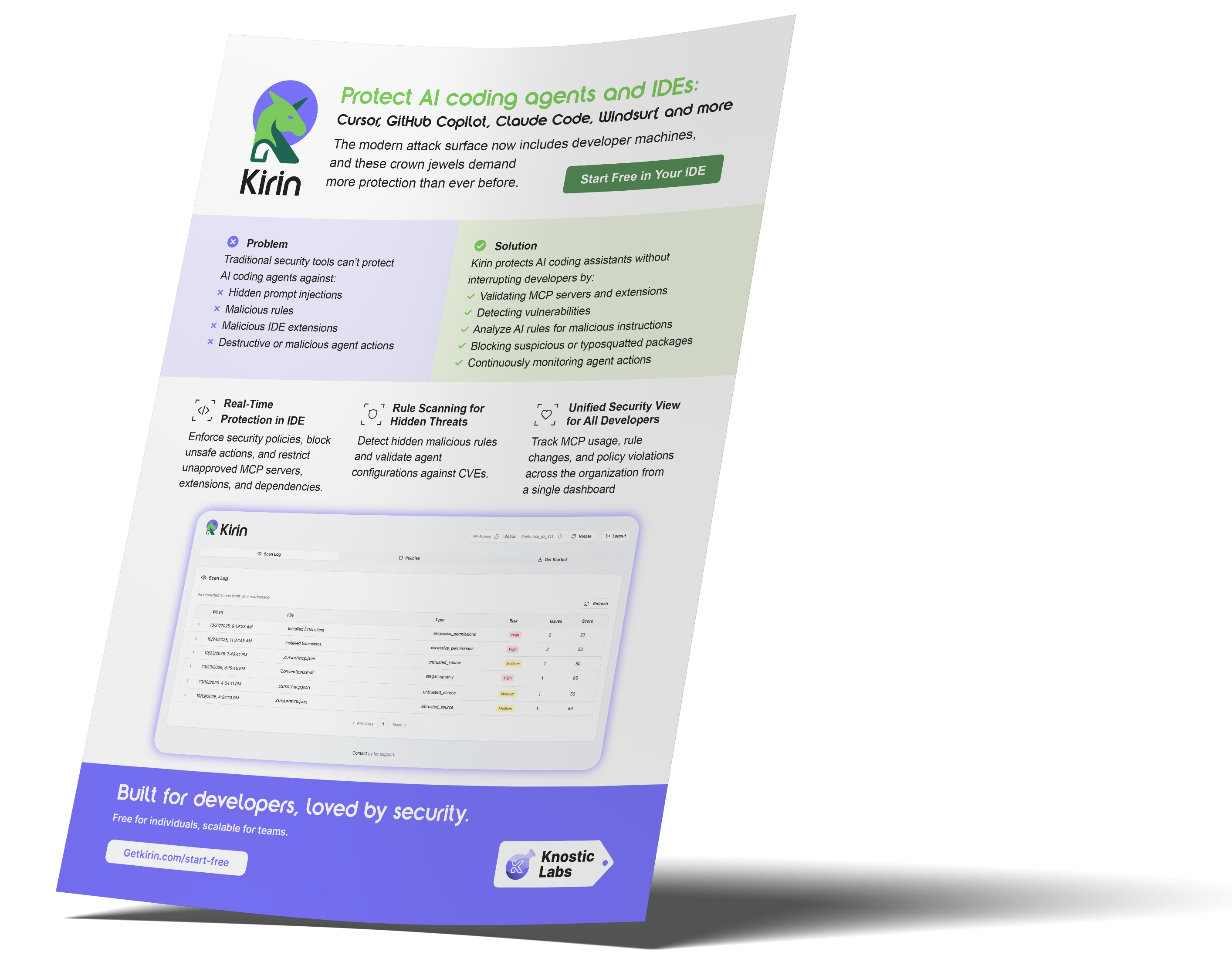
Kirin by Knostic Labs enforces code policy at runtime outside the model. It evaluates output after generation and before it reaches editors or repos, stopping violations deterministically. It scans AI-generated code for hardcoded secrets, insecure defaults, disallowed libraries, and license conflicts before commit or execution. Demos show that Cursor can inject insecure code without such enforcement.
On violation, Kirin can block, redact, or replace output, removing policy interpretation from developers and keeping teams consistent. Rules adapt to role, repository, environment, and risk, strict in production and flexible in experiments. Every decision is logged with the rationale and the applied policy, enabling audits, investigations, and compliance. Cursor alone lacks this external, context-bound runtime control.
FAQ
- Why doesn’t Cursor follow coding rules?
Cursor is a probabilistic language model that optimizes for code-completion quality rather than rule enforcement, so rules provided via prompts are treated as guidance rather than hard constraints. As context grows or tasks become complex, earlier instructions lose priority and violations occur silently.
- Why isn’t prompt engineering enough to enforce Cursor’s rules?
Prompt engineering cannot guarantee enforcement because the model can override, ignore, or reinterpret instructions as context changes. Without an external runtime control layer, prompts remain advisory and cannot block unsafe or non-compliant code deterministically.
- What kinds of rules can Kirin enforce for Cursor?
Kirin can enforce rules for secure coding practices, secret handling, disallowed libraries, licensing constraints, data exposure, and environment-specific policies. These rules are applied at runtime, outside the model, ensuring consistent enforcement regardless of prompt behavior.
Subscribe to our blog!

Data Leakage Detection and Response for Enterprise AI Search
Learn how to assess and remediate LLM data exposure via Copilot, Glean and other AI Chatbots with Knostic.


The Data Governance Gap in Enterprise AI
See why traditional controls fall short for LLMs, and learn how to build policies that keep AI compliant and secure.

Rethinking Cyber Defense for the Age of AI
Learn how Sounil Yu’s Cyber Defense Matrix helps teams map new AI risks, controls, and readiness strategies for modern enterprises.

Extend Microsoft Purview for AI Readiness
See how Knostic strengthens Purview by detecting overshared data, enforcing need-to-know access, and locking down AI-driven exposure.

Build Trust and Security into Enterprise AI
Explore how Knostic aligns with Gartner’s AI TRiSM framework to manage trust, risk, and security across AI deployments.

Real Prompts. Real Risks. Real Lessons.
A creative look at real-world prompt interactions that reveal how sensitive data can slip through AI conversations.

Stop AI Data Leaks Before They Spread
Learn how Knostic detects and remediates oversharing across copilots and search tools, protecting sensitive data in real time.
Accelerate Copilot Rollouts with Confidence
Equip your clients to adopt Copilot faster with Knostic's AI security layer, boosting trust, compliance, and ROI.

Reveal Oversharing Before It Becomes a Breach
See how Knostic detects sensitive data exposure across copilots and search, before compliance and privacy risks emerge.

Unlock AI Productivity Without Losing Control
Learn how Knostic helps teams harness AI assistants while keeping sensitive and regulated data protected.

Balancing Innovation and Risk in AI Adoption
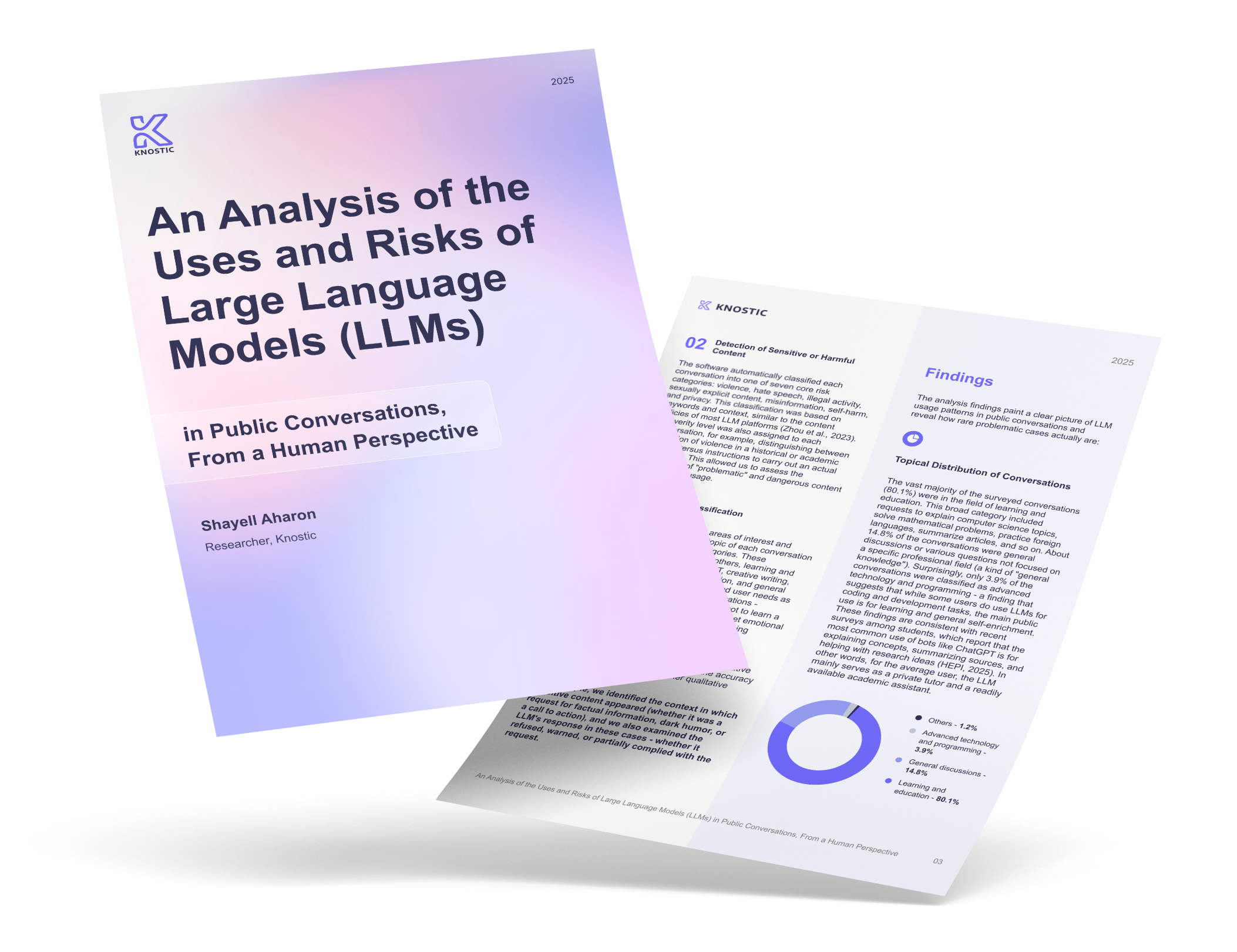
A research-driven overview of LLM use cases and the security, privacy, and governance gaps enterprises must address.

Secure Your AI Coding Environment
Discover how Kirin prevents unsafe extensions, misconfigured IDE servers, and risky agent behavior from disrupting your business.