


What This Blog Post on MCP Server Security Vetting Covers
-
MCP servers are high-privilege components that expand the AI agent’s system access, often without formal review, making them significant attack vectors if misconfigured or malicious.
-
Developers commonly deploy MCP servers from public sources without vetting, introducing hidden risks and bypassing traditional software approval processes.
-
Vetting should include source code integrity checks, permission audits, dependency scans, and governance reviews, ensuring the server is legitimate, minimally scoped, and policy-compliant.
-
Continuous monitoring is critical to catch configuration drift, behavioral anomalies, and silent privilege escalations. It uses runtime scoring, behavioral baselines, and end-to-end audit logs.
-
Operationalizing vetting with structured workflows, inventory tracking, and developer guardrails builds consistency and reduces misconfigurations. Solutions like Kirin enable real-time enforcement and visibility.
The Security Implications of MCP Servers
Every MCP server you approve becomes part of your AI supply chain, but most are never vetted. Many teams deploy MCP servers because they simplify access to tools, files, APIs, and system capabilities for coding agents. Developers trust them because they come from GitHub repos or example configs. However, that trust is rarely verified through the MCP server security vetting.
MCP servers extend the agent’s reach far beyond the user interface and operate with elevated privileges within the development environment. They can read files, run commands, send outbound traffic, and modify workflows. When these servers are misconfigured or malicious, they become critical compromise vectors. An unauthorized or unsafe MCP server can breach isolation, escalate access, and trigger high-impact actions across the entire enterprise.
High Privilege by Default
Most MCP endpoints require broad system, file, and API access to function. This means the server can read directories, execute commands, and interact with sensitive internal tooling. High privilege increases convenience for developers but expands the blast radius if something goes wrong.
IBM’s 2024 X-Force Threat Intelligence Index revealed that abuse of valid accounts surged, accounting for 30% of all incidents in 2023. It also found that unvetted MCP servers can directly contribute to this risk because they operate beyond traditional identity boundaries and execute actions without re-authentication. Unvetted MCP servers actively increase exposure by requesting more access than they need and enabling lateral movement through trusted automation channels.
Rapid Adoption Without Review
Developers add MCP servers quickly because they appear in documentation, repos, conference demos, and Slack posts. The speed of adoption means the security review rarely happens before deployment.
As reported in ITPro, 94% of IT professionals use AI tools, yet only 39% of organizations build robust internal frameworks to support their AI adoption. This pattern repeats in MCP workflows, where developers trust examples posted by strangers online. The lack of formal checks creates blind spots in supply-chain hygiene. Furthermore, unverified servers bypass established software procurement controls. This behavior exposes enterprises to unplanned and unmanaged risk. Also, according to Financial News (London), a survey of firms using AI found that although 90% use AI, fewer than 1 in 5 organizations have established internal guidelines to govern its use.
Hidden Attack Channels
MCP servers can open hidden attack channels inside the IDE. They can inspect environment variables, scrape configuration files, and trigger commands the developer did not explicitly request. This makes them valuable to attackers who want stealthy access. An unsafe MCP server can also redirect or mutate API calls in ways the agent treats as legitimate. These invisible channels allow threat actors to operate within the development workflow without triggering alerts. This risk grows as teams integrate multiple AI agents and background services.
Silent Threat Surface Expansion
Each new MCP server adds dozens of new access paths inside the enterprise environment. The expansion is not apparent because the server hides behind the assistant’s interface. Most developers do not track what files, processes, or APIs an MCP server touches.
Large organizations struggle to measure this growth, and visibility gaps remain a persistent problem in cloud environments. One cloud security report highlights industry studies, which note that unmanaged access is a recurring driver of exposure rather than an exception. The IBM Security Cost of a Data Breach Report 2025 also discusses “shadow data,” noting that 35% of breaches involved data from unmanaged sources. MCP servers fit this pattern because they operate at the intersection of code execution and agent amplification. The threat surface grows silently until an issue emerges in production.
What to Vet Before Approving an MCP Server
Vetting an MCP server is essential because these components run in the developer environment and often have elevated permissions. A thorough review prevents unsafe or unauthorized servers from entering workflows that interact with source code, files, APIs, and system tools. Proper vetting blocks supply-chain infiltration attempts and reduces the chances that malicious or tampered components gain access to the development ecosystem. ENISA’s 2024 software and supply-chain security report shows that attackers increasingly target integration points and injected components because they are not consistently reviewed, making structured vetting a critical control for modern environments.
Source Code Integrity Review
A source code integrity review verifies that the MCP server is authentic, transparent, and free from hidden behavior. Reviewers first confirm that the repository belongs to the correct maintainer and has not been tampered with. They also examine commit history, contributor patterns, and unusual activity to detect hijacking attempts, and inspect modules for obfuscation, encoded payloads, and suspicious imports that may hide remote-execution logic. GitHub’s security documentation notes that malicious packages sometimes include concealed script triggers or unexpected network requests in dependency trees, reinforcing the need to audit execution paths.
Permission & Capability Model
The MCP permission model defines what an MCP server can interact with inside the environment. Reviewers map each capability to the server’s purpose to confirm that no excessive or unrelated permissions are requested. Least-privilege guidelines require that servers have only the minimum access necessary to perform specific tasks. MCP servers that request system-wide file access or unrestricted shell execution must be carefully examined, as these permissions create robust attack vectors. Network access and tool-execution capabilities must also be evaluated, as they can enable lateral movement. A clear capability model prevents privilege creep and ensures that the server cannot escalate actions beyond its intended scope.
Dependency and Supply Chain Analysis
Dependency analysis ensures that the MCP server does not rely on unsafe or compromised external packages. Reviewers examine all dependencies from registries such as npm and PyPI to detect tampered, unmaintained, or suspicious components. They check for typosquats and impersonated packages, which remain common vectors in supply-chain attacks. A well-known example is the malicious “ctx” package uploaded to PyPI, which impersonated a legitimate library and executed remote code upon installation, illustrating how a simple typosquat can compromise systems even before runtime.
Security History & Reputation
Security reputation provides insight into an MCP server's long-term reliability. Reviewers check whether the project has previously encountered incidents or unresolved issues. They evaluate how maintainers respond to vulnerability disclosures and whether they follow responsible reporting practices. Projects with unclear governance or inconsistent update patterns may also indicate elevated risk. Assessing reputation helps organizations avoid adopting components with a history of poor security hygiene.
License & Governance
License and governance checks ensure that the MCP server aligns with organizational policy and legal requirements. Reviewers verify that the project’s license is compatible with enterprise rules and does not impose conditions that conflict with internal policies. Diligent MCP governance is critical because many open-source components shift maintainers or ownership over time. NIST emphasizes the importance of transparent governance and stable stewardship in ensuring the long-term reliability of software components. Contributor lists must be examined to confirm that unknown or suspicious accounts do not hold push or release privileges. Any irregularities in governance structures may indicate a risk of compromised updates or unauthorized access.
Continuous Monitoring Techniques for MCP Servers
Continuous monitoring ensures that approved MCP servers remain safe over time. It is necessary because configuration drift, dependency updates, and changing developer workflows can alter server behavior. Monitoring gives real-time visibility into file access, shell execution, and outbound calls. Runtime monitoring is needed because NIST confirms that continuous, real-time visibility into build and execution environments significantly shortens detection and response time for anomalous activity, especially in automated development pipelines. Without monitoring, MCP servers can drift into unsafe configurations without detection. Monitoring also supports compliance by generating auditable logs, which provide traceability when incidents occur. Continuous oversight turns vetting from a one-time control into a living defense mechanism.
Behavioural Monitoring
Behavioral monitoring tracks how the MCP server behaves during real use. It records file operations to detect when the server accesses unexpected directories and monitors shell commands to spot dangerous or unrequested execution. It also logs API calls to detect unauthorized outbound communication and captures IDE interactions that may reveal unusual automation patterns. Behavioral monitoring identifies bursty behavior that can sometimes indicate exfiltration or script injection. This monitoring provides a behavioral baseline for safe operation.
Configuration Drift Detection
Configuration drift occurs when the server changes in ways the enterprise did not approve. Drift may appear after an update, dependency change, or manual modification. For example, a post-deployment update to an internal server introduced a new file-write capability that had not been reviewed, and drift monitoring surfaced the change within minutes, allowing the server to be isolated before the behavior propagated.
Drift detection alerts teams when capabilities expand, permissions shift, or new behaviors emerge. This prevents silent privilege creep. By detecting drift early, teams maintain the original assurance level from the vetting phase. This protects systems from unexpected changes.
Runtime Reputation Scoring
Runtime reputation scoring estimates a server's risk as it operates. The score considers access scope, observed behavior, usage patterns, and past incidents. It changes as more telemetry becomes available. Risk thresholds are defined by AppSec and platform teams based on baseline behavior and approved capability boundaries, ensuring consistency for secure MCP deployment. False positives are reduced through staged warning levels, where deviations trigger alerts before enforcement actions are applied, allowing validation without disrupting development. Risk scoring helps teams prioritize which servers need deeper review. Reputation models reflect how the server behaves in reality rather than only on paper. This dynamic assessment reduces blind trust and improves response speed.
End-to-End Auditing
End-to-end auditing captures every request, response, and action executed through the MCP server. Each action is tied to a specific developer, agent, or system identity. This traceability creates accountability. Auditing supports compliance requirements by producing verifiable logs.
When incidents occur, auditing enables forensic reconstruction of events. Enterprise teams use these logs to identify misuse, malicious MCP server detection, and/or configuration errors. Complete auditing ensures the MCP environment remains transparent and defensible.
MCP Server Vetting Checklist
An MCP Vetting Checklist should include:
☐ Source code reviewed (Critical)
☐ Maintainer identity verified (Critical)
☐ Dependencies scanned and approved (Critical)
☐ Permissions documented and minimized (Critical)
☐ Network behavior analyzed (Critical)
☐ Outbound traffic restricted (Recommended)
☐ No hardcoded secrets (Critical)
☐ Logging and auditing enabled (Recommended)
☐ Sandbox tests completed (Recommended)
☐ Approved by AppSec and Platform teams (Critical)
Automation can enforce these controls through policy-as-code, pre-merge validation, and CI/CD-based configuration checks using native platform capabilities such as GitHub Actions or equivalent internal pipelines.
Operationalizing MCP Vetting in Enterprises
Operationalizing MCP vetting requires turning a one-time review into a repeatable, traceable enterprise process tightly integrated with the organization’s broader AI coding assistant governance model. Large teams need consistent rules because MCP servers often move between environments, developers, and projects. A stable process also ensures that the same criteria are used to judge every server. This removes subjective decisions and protects the organization from uneven security practices. Enterprises that standardize vetting see fewer misconfigurations because the workflow enforces validation before a server is allowed into production. Operationalizing the framework also improves accountability by making ownership clear at each stage. When the process is embedded inside developer workflows, MCP vetting becomes natural rather than disruptive.
Approval Workflow
The approval workflow begins with a formal submission by the developer or team requesting the MCP server. The server is then scanned automatically to detect obvious issues before deeper manual review. After scanning, security reviewers analyze source code, permissions, network behavior, and dependency health. The server is then moved into a sandbox environment where behavior is observed under controlled conditions. Test logs help identify any unexpected file access, outbound communication, or command execution. Only after these steps are completed does the server enter a final approval stage by AppSec and platform engineering.
Inventory Management
Inventory management ensures that the organization always knows which MCP servers are active. Each server must be recorded with metadata such as version, permissions, ownership, and update history. This inventory makes it easier to detect abandoned or outdated servers that may introduce unnecessary risk. It also helps platform teams track when a server changes capabilities or undergoes a significant update. Without inventory oversight, MCP servers can multiply silently across teams. This lack of visibility increases the chance of configuration drift and inconsistent security levels. Ultimately, a centralized inventory system maintains a controlled, predictable environment.
Developer Guardrails
Developer guardrails reduce the risk of accidentally adding unsafe MCP servers. Guardrails restrict the use of marketplaces or repositories to approved sources only. They guide developers toward a pre-vetted catalog so they do not use unknown or unverified components. Automated blocking of non-approved MCP servers prevents accidental bypass of security controls. Guardrails also reduce cognitive load because developers do not need to make security decisions on their own. When guardrails are present, the environment becomes safer by default. These mechanisms support security without slowing down development.
Kirin: Continuous MCP Inspection
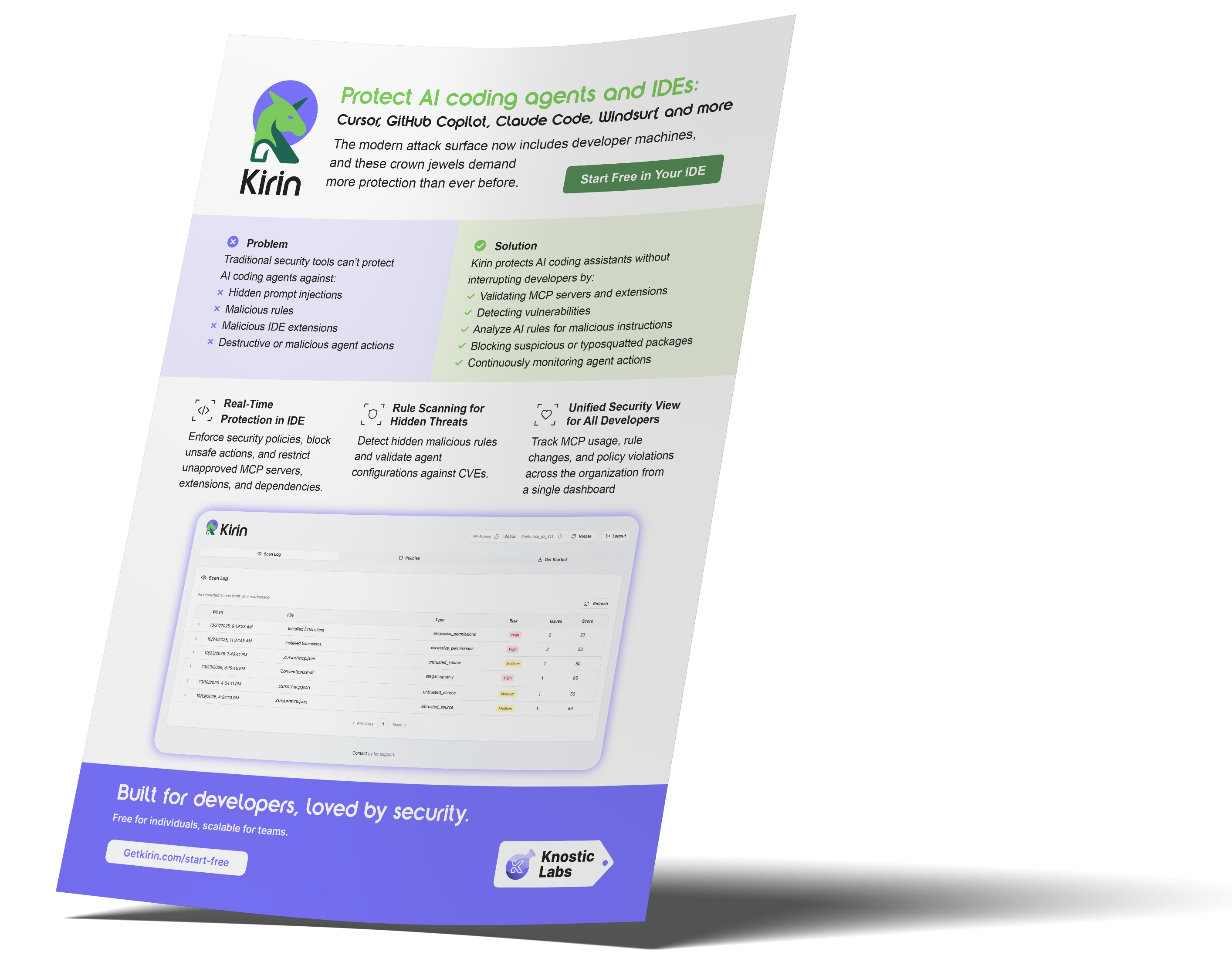
Kirin by Knostic Labs improves MCP vetting by adding real-time, continuous inspection across the entire development environment. It integrates directly at the IDE runtime layer and can also connect to CI/CD pipelines, allowing organizations to enforce MCP policies during both local development and automated build stages. It gives organizations visibility into every incoming and outgoing connection between MCP servers and coding agents.
In addition, Kirin automatically validates configuration changes and warns teams when a server begins requesting new permissions. It maintains a complete inventory with dynamic reputation scoring that reflects observed behavior rather than static configuration. Kirin also generates alerts when capabilities expand unexpectedly or when a server attempts actions outside its approved boundary. The system blocks unauthorized or malicious MCP servers before they affect developer workflows. Continuous behavioral monitoring ensures that servers remain trustworthy long after the initial vetting.
Your AI agents can only be as safe as the MCP servers they trust, and Kirin makes that trust enforceable.
FAQ
- What does “vetting an MCP server” actually mean in enterprise environments?
Vetting an MCP server means reviewing its code, permissions, dependencies, and behavior before allowing it into developer workflows. It ensures the server is trustworthy, properly scoped, and safe to integrate with enterprise systems.
- What are the most important criteria when deciding whether to approve an MCP server?
Enterprises should focus on code transparency, minimal permissions, clean dependencies, and predictable network behavior. They should also evaluate maintainer reputation and governance to ensure long-term safety.
- How can teams continuously monitor MCP servers after approval?
Teams can use real-time monitoring, configuration drift detection, and behavioral logging to track changes and detect anomalies. These controls ensure the server remains safe even as it updates or interacts with new tools.
Subscribe to our blog!

Data Leakage Detection and Response for Enterprise AI Search
Learn how to assess and remediate LLM data exposure via Copilot, Glean and other AI Chatbots with Knostic.


The Data Governance Gap in Enterprise AI
See why traditional controls fall short for LLMs, and learn how to build policies that keep AI compliant and secure.

Rethinking Cyber Defense for the Age of AI
Learn how Sounil Yu’s Cyber Defense Matrix helps teams map new AI risks, controls, and readiness strategies for modern enterprises.

Extend Microsoft Purview for AI Readiness
See how Knostic strengthens Purview by detecting overshared data, enforcing need-to-know access, and locking down AI-driven exposure.

Build Trust and Security into Enterprise AI
Explore how Knostic aligns with Gartner’s AI TRiSM framework to manage trust, risk, and security across AI deployments.

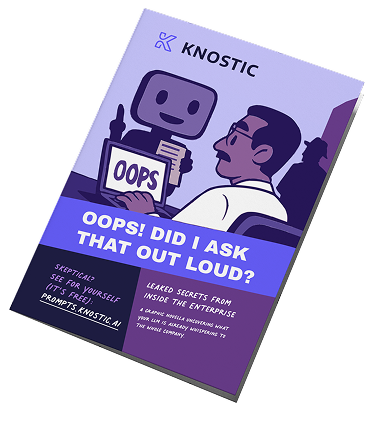
Real Prompts. Real Risks. Real Lessons.
A creative look at real-world prompt interactions that reveal how sensitive data can slip through AI conversations.

Stop AI Data Leaks Before They Spread
Learn how Knostic detects and remediates oversharing across copilots and search tools, protecting sensitive data in real time.
Accelerate Copilot Rollouts with Confidence
Equip your clients to adopt Copilot faster with Knostic's AI security layer, boosting trust, compliance, and ROI.

Reveal Oversharing Before It Becomes a Breach
See how Knostic detects sensitive data exposure across copilots and search, before compliance and privacy risks emerge.

Unlock AI Productivity Without Losing Control
Learn how Knostic helps teams harness AI assistants while keeping sensitive and regulated data protected.

Balancing Innovation and Risk in AI Adoption
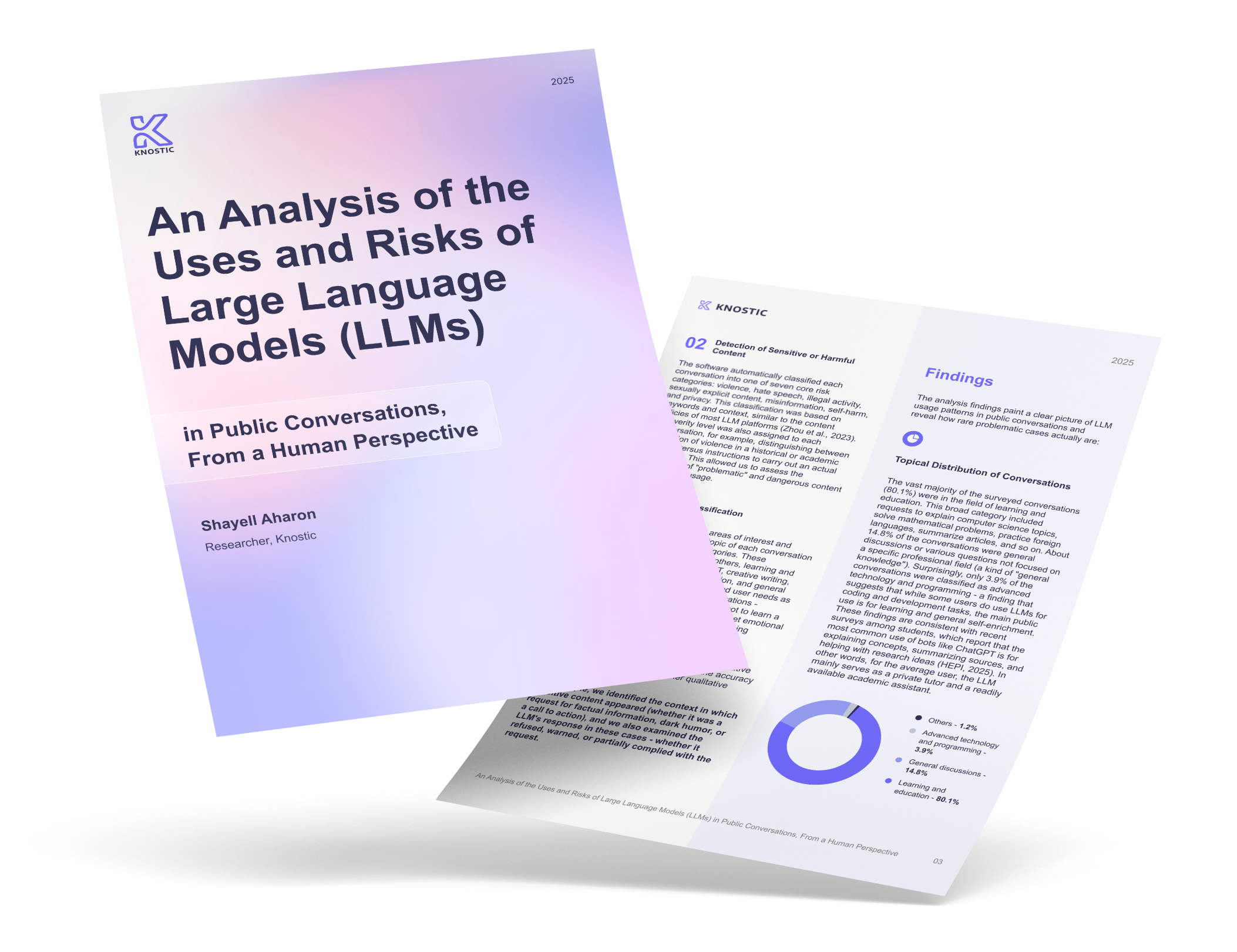
A research-driven overview of LLM use cases and the security, privacy, and governance gaps enterprises must address.

Secure Your AI Coding Environment
Discover how Kirin prevents unsafe extensions, misconfigured IDE servers, and risky agent behavior from disrupting your business.