


What This Post on AI Supply Chain Secret Sprawl Covers
-
Secret sprawl is the uncontrolled spread of sensitive credentials across AI-assisted development tools that automatically ingest, store, and share data.
-
The AI toolchain, including IDEs, MCP servers, AI coding agents, and browser-based assistants, transmits secrets across layers without developer intent or oversight.
-
Traditional secret management tools fail because they secure storage, not exposure, leaving secrets vulnerable once accessed by AI tools.
-
Realistic failure scenarios demonstrate how a single credential can quickly propagate across systems, logs, and code through automated AI behaviors.
-
Key mitigation strategies include eliminating plaintext secrets, using scoped tokens, enforcing access boundaries, redacting context data, and integrating secret scanning into development workflows.
The Unseen Spread of Secrets Across the AI Development Supply Chain
AI did not just change how developers write code. It fundamentally altered how secrets are used. The expansion of AI-assisted development created a supply chain far more complex than the traditional model that focused on vendor contracts, open-source libraries, and cloud providers. This is the driving force behind AI supply chain secret sprawl. Today’s chain includes LLMs that ingest entire workspaces, IDE extensions that scan project metadata, MCP servers that run high-privilege backend processes, AI agents that autonomously read and modify files, cloud copilots that require extensive permissions, and even browser-based AI integrations that store conversations and histories. Each component independently collects contextual information to improve its behavior, and this context often contains sensitive tokens, API keys, and environment variables.
The problem is that these tools do not simply access secrets. Rather, they duplicate, tokenize, and move them between layers of the development environment without explicit developer intent. Evidence for this kind of uncontrolled propagation has been shared in numerous independent research papers. Revelations include the discovery of over 12 million leaked secrets in public GitHub repositories in 2023, a 113% increase since 2021, demonstrating how fragile modern development pipelines have become. Another recent investigation of leading AI companies published in ITPro found that 65% had exposed verified, working credentials in public repositories This shows that even sophisticated teams are unable to contain secret proliferation once AI-assisted workflows become part of daily development.
The research proves something has changed. Secret sprawl is no longer a narrow engineering oversight. Now it’s one of the most dangerous and least visible AI supply chain risks.
What Secret Sprawl Means in the Modern AI Toolchain
Secret sprawl in the AI toolchain refers to the uncontrolled, multi-hop movement of sensitive credentials across tools that continuously ingest, store, and propagate contextual data. This process can be better understood as a form of non-consensual credential duplication, where secrets travel into tools, layers, and storage systems the developer never intended to expose.
Modern AI development tools read far more than a single file or snippet. This is because LLMs and coding agents rely on broad environmental awareness, including workspace structure, configuration files, logs, metadata, and environment variables. In a post, About secret scanning, GitHub confirmed, through its security scanning documentation, that sensitive tokens are frequently found in these artifacts. This is because they are routinely stored in configuration directories, command histories, and development environments that AI tools automatically ingest. As soon as one tool reads this data, it is often available to another, creating an invisible chain. It results in IDE ingestion, followed by MCP server processing, AI agent consumption, cloud API forwarding, and even browser extension caching. This chain is rarely monitored end to end, and no single security or platform team has ownership of every system involved.
When developers open a project in an AI-enabled IDE, the assistant may read environment variables. When the developer triggers an MCP-powered operation, the underlying server may log environment variables. And when an AI agent summarizes errors, these logs may be passed to an LLM without anyone realizing sensitive data is included. Secret sprawl occurs precisely because these flows occur automatically, often without an explicit user action, making the resulting exposures extremely difficult to detect with traditional scanning or vaulting approaches.
Where Secret Sprawl Happens
In essence, secret sprawl in AI systems happens when tools connect and convenience outruns governance, letting credentials slip across tools and contexts.
IDE Exposure
Exposure within IDEs remains one of the most persistent and underestimated contributors to AI-related secret sprawl, as modern IDEs operate as fully integrated execution layers rather than passive text editors. When developers store secrets in .env files, configuration folders, or cached credentials, these artifacts become immediately accessible to IDE features and extensions that attempt to analyze the project structure or provide intelligent suggestions.
In Keeping secrets secure with secret scanning, GitHub shares its own secret-scanning analysis. This reveals that sensitive tokens routinely appear in configuration files, editor histories, cached development artifacts, and machine-level metadata. It illustrates clearly how easily IDE ecosystems accumulate plaintext secrets in locations developers rarely inspect and security teams do not monitor.
MCP Servers
MCP servers introduce a uniquely high-risk environment for secret sprawl because they sit between the developer’s IDE and backend tools, often with elevated privileges and access to sensitive environment variables. By design, MCP servers provide LLMs and agents with structured interfaces to interact with tools, databases, or cloud services. What this means is that server responses frequently contain contextual information the AI uses to make decisions. However, because these servers often execute commands, run diagnostics, or print environment variables as part of error handling or debugging routines, they can unintentionally expose credentials in logs or outputs that an LLM may later ingest.
The OWASP AI Testing Guide explicitly warns that AI configuration files, tool outputs, and agent interactions pose documented risks of secret exposure. This aligns with concerns that an MCP server secret leakage can unintentionally propagate to downstream tools.
AI Coding Agents
AI coding agents amplify secret sprawl by operating as autonomous participants in the development workflow, reading, transforming, and rewriting files across the repository. Their design encourages them to ingest as much context as possible. This often includes sensitive tokens embedded in configuration files, logs, or environment metadata, underscoring the need for robust credential management. Once an agent observes a secret, it may unintentionally replicate it when generating code, constructing example commands, or creating new configuration files, thereby increasing the total number of secret copies in the repository. Behavior like this aligns with the broader empirical evidence of large-scale secret exposure in public code, such as the discovery of millions of leaked credentials across repositories documented in independent research.
External AI Tools
External AI tools introduce additional exposure pathways because developers frequently paste logs, error messages, or configuration values into browser-based LLM interfaces to troubleshoot issues. These interfaces often store conversation histories, and many browser extensions or integrations automatically save prompts locally, making it easy for credentials to persist outside traditional development or security pipelines. When users share API responses or configuration blocks with external LLMs, secrets that were initially intended for local use may become part of a remote prompt history. This can be highly problematic given that studies have shown how frequently sensitive credentials end up in public or semi-public datasets. For example, the results of an ITPro investigation published by Cornell University in 2024, revealed that over half of leading AI companies unintentionally leaked working credentials in online repositories. This demonstrates how easily sensitive data can migrate once copied outside controlled environments.
Why Traditional Secrets Management Doesn’t Apply Here
Traditional secrets management approaches fail in AI-driven environments because they focus exclusively on securing storage rather than securing exposure, and exposure is precisely what proliferates secrets in AI contexts. Vaults work well as controlled repositories for issuing, rotating, and auditing credentials, but they do not control how secrets move once they leave the vault and become part of an AI tool’s context window. As a result, the problem of secret sprawl cannot be solved by simply improving vault practices; it requires protecting every step of the AI toolchain where secrets may appear, move, or be replicated.
Realistic Secret Management Failure Scenarios
Secret sprawl in the AI supply chain rarely makes the front page on day one. It starts as a handful of “quick fixes” and spreads quietly until every environment is contaminated. Most organizations only discover the problem when an incident response team starts tracing an unexpected API bill, a suspicious database query, or a compromised MCP server back through multiple AI-assisted workflows. The following three scenarios are not edge cases. They represent how genuine AI supply chains actually fail.
Quick Test leads to Failure
“We just stopped an issue like this for a customer, where the cursor uploaded a key to Cursor.”
In one real-world incident, a team discovered that a developer had pasted a long-lived API key into a Cursor editor buffer “just for a quick test,” assuming the key would never leave their laptop. The AI assistant ingested that buffer into its context, stored it in its workspace state, and then synchronized that state back to a remote service, effectively “uploading a key to Cursor” without any explicit user intent.
From the developer’s point of view, nothing malicious happened here: no red warnings, no failed builds, just a successful test call and a quiet commit. From a supply-chain perspective, that single action created at least three independent exposure points: local history, remote assistant storage, and any generated code snippets that reused the credential.
GitHub’s training materials for secret scanning underscore how typical this pattern is, noting that “well over a million tokens” are discovered on the platform each year, much of it in places developers assumed were invisible. What looks like a single “local” test in an AI-enhanced IDE becomes a multi-system propagation event in minutes, and without explicit guardrails, nobody is watching the full path.
MCP Server Prints Env Vars → AI Reads → Secret Leaks
A second pattern emerges when MCP servers and tools expose environment variables during debugging.
An engineer enables verbose logging on a custom MCP server to troubleshoot a failing integration and prints the entire environment into a JSON response that flows back through the AI toolchain. The IDE plugin dutifully forwards that response into the LLM context window; the agent summarizes the output; and the resulting logs or transcripts are persisted in yet another system, sometimes a collaboration tool or an incident wiki.
Published research on secrets in codebases has shown that environment and configuration files can contain dozens of distinct secrets per project, ranging from database URIs to cloud provider keys and internal admin credentials. When those values are printed once and ingested by an AI tool, they stop being just environment variables and become part of a much larger and harder-to-control corpus that can later resurface in suggestions, summaries, or logs.
AI Assistant Replicates Secrets Across Repo
The third scenario is even more insidious because it feels helpful while doing real damage.
A developer asks an AI coding assistant to “wire up this service across all the modules that need it,” and the assistant discovers a working API key in one config file and reuses it throughout the codebase. What started as a single secret in one file quietly becomes five, ten, or twenty separate instances spread across multiple folders and configuration patterns.
What the Research Shows About Secret Propagation
A study, published by Cornell University, discusses empirical work on secret-asset relationships in repositories. It shows that individual secrets often appear in multiple locations and patterns within the same project. This is why tools like AssetHarvester had to define four distinct co-location patterns and achieved a 94% F1-score to track secrets properly as they spread. When an AI assistant participates in this propagation, the number of cleanup locations after rotation increases dramatically, turning a single remediation task into a repository-wide hunt.
Other comparative evaluations of secret-detection tools have confirmed how easily real exposures escape automation, with the top-performing scanner achieving only 75% precision and no tool reaching higher than 88% recall. This means that even the best systems routinely miss valid secrets, especially when they appear in unconventional file types or patterns, the exact conditions created by AI-driven replication. By the time anyone notices the problem, the original leak has multiplied into an entire class of findings that must all be fixed before the system can be considered safe again.
5 Core Mitigation Strategies
A well-established practice is to stop secret sprawl in AI development by treating credentials as toxic assets and designing the pipeline to minimize their presence, tightly constrain their use, and automatically intercept exposure from editor to model to production.
1. Eliminate Plaintext Secrets
The first step is to stop giving AI tools easy food. As long as secrets live in plaintext in .env files, YAML configs, or inline code, any AI assistant that reads those files can absorb and reuse them without resistance. Multiple empirical studies have shown that the majority of exposed credentials in AI workflows in real-world repositories remain simple, hard-coded values. One benchmark dataset of 818 projects, capturing 97,479 secrets, of which over 15,000 were confirmed to be true secrets, were heavily concentrated in configuration and infrastructure files.
Credentials should live in dedicated secret-management systems or environment-specific stores that are never checked into source control or written into human-readable project files. Even when absolute elimination is impossible, reducing the density and visibility of secrets in working directories shrinks the attack surface that AI tools can accidentally harvest.
2. Use Ephemeral, Scoped Tokens
The second strategy assumes that some leaks will still happen and focuses on minimizing their impact. Long-lived, broad-scope tokens are the worst possible input to an AI toolchain because any accidental exposure creates a high-value, long-duration target.
Research on hard-coded secrets published over the years has repeatedly emphasized the cost of this pattern. Multi-year studies have found that the same types of database and cloud secrets reappeared across versions and forks, and that developers often left them active for months or years rather than rotating them after each leak.
By contrast, ephemeral tokens that expire quickly and are limited to a narrow set of actions drastically reduce the blast radius when an IDE extension or MCP server ingests them. Even if an AI agent surfaces a token in a generated snippet or a log, the window of opportunity for abuse is short, and the scope of what an attacker can do with it is constrained by design. This means it is important to align token lifetimes with real task durations (hours or days, not months) and design scopes around specific workflows rather than entire platforms or accounts.
3. Enforce Boundaries for AI Tools
The third control recognizes that AI tools are often given more visibility than they need. IDE assistants, MCP servers, and custom agents are typically configured with broad file-system or environment access “to make them more helpful.” Still, that same freedom allows them to hoover up secrets from directories and variables that have nothing to do with the task at hand.
Enforcing boundaries in practice means scoping which folders an IDE extension can read, which environment variables an MCP server can print or forward, and which repositories an agent can access from a given workspace. It also means treating AI tools as separate identities in access-control systems, with policies and monitoring distinct from their human operators.
4. Redact and Filter Context
Even with better storage and access controls, some secrets will appear in the text streams that feed AI models. The fourth strategy is to filter those streams before they ever reach the LLM. Context-redaction layers can scan prompts, tool outputs, and server responses for patterns that match credentials and either mask or strip them before forwarding the rest of the content.
Techniques developed in recent secret-analysis tools show that pattern-matching combined with data-flow awareness can achieve precision above 95% and recall around 90% for secret-asset detection. This demonstrates that it is technically feasible to separate sensitive tokens from surrounding business logic without breaking functionality. Applying similar ideas to the AI context streams allows organizations to preserve the usefulness of logs, stack traces, and configuration snippets while automatically removing the very values that attackers care about most.
5. Integrate Secrets Scanning Into PRs and IDEs
The final mitigation closes the loop between human workflows and automated protections. GitHub’s own rollout of free secret scanning for public repositories demonstrated this at scale. Organizations that enabled it uncovered hundreds or thousands of previously unnoticed secrets across their code history. Putting these capabilities directly into IDEs and pull-request pipelines ensures that most leaks are detected at the moment of creation, before AI tools have a chance to ingest them and spread them further. When scanners run on every commit, push, or merge, they act as early-warning systems that prevent secret sprawl from ever entering the AI supply chain.
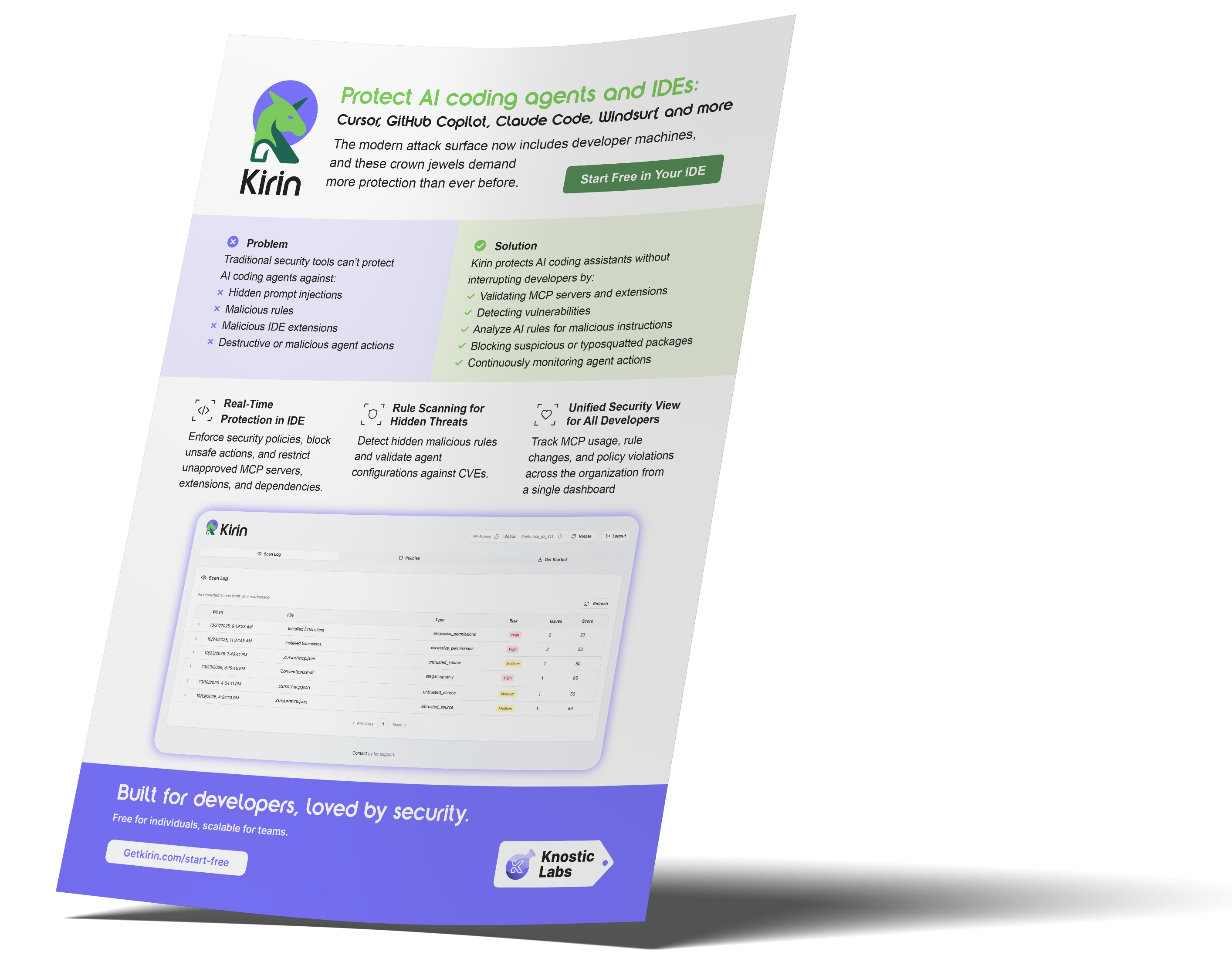
Stopping Secret Sprawl at the Source with Kirin by Knostic Labs
All of these practices are necessary, but they are not sufficient on their own. This is simply because they do not address the AI-specific behaviors that make secret sprawl so hard to see. Kirin by Knostic Labs is designed to sit directly in the AI supply chain, watching how IDEs, MCP servers, and coding agents handle context in real time and enforcing policies that traditional security tools cannot reach. Instead of just scanning static repositories, the tool observes the live streams of prompts, tool outputs, and responses that drive AI development workflows and intervenes when secrets or other sensitive data begin to move in unsafe ways. It responds by redacting secrets inside IDEs before they are sent to LLMs, blocking prompt-injection patterns that try to trick agents into exfiltrating credentials and enforcing least-privilege policies on which files, variables, and repositories an AI tool is allowed to access.
Kirin also monitors MCP server behavior, detecting when environment variables or high-risk configuration values are being echoed back into contexts where they do not belong. Because every decision is logged, security and platform teams get an audit trail of AI interactions. This in turn shows exactly when a secret was blocked, where a prompt-injection attempt occurred, and how context was filtered before reaching the model. In effect, the solution becomes the missing control plane for AI data flows, turning opaque AI behavior into something that can be governed, measured, and improved.
FAQ
- What exactly is “secret sprawl” in the AI supply chain?
Secret sprawl refers to the uncontrolled movement and duplication of sensitive credentials across AI-enabled tools such as IDEs, MCP servers, coding agents, and browser integrations. Because these tools automatically ingest and transform large amounts of context, secrets begin appearing across multiple systems, logs, and generated files without developers realizing it.
- Where do secrets most commonly leak in modern AI workflows?
Most leaks originate in developer workstations, specifically environment files, cached credentials, configuration directories, and verbose tool outputs that AI assistants routinely ingest. Studies show that millions of these secrets end up exposed because AI tools replicate them into code, logs, and prompts, creating multi-hop leaks across the toolchain.
- How does Kirin help prevent secret sprawl across the AI supply chain?
Kirin intercepts sensitive values before they reach LLMs, redacting them in real time and blocking any agent behavior that attempts to exfiltrate or replicate secrets. It also enforces strict ingestion boundaries, monitors MCP server outputs, and generates audit logs that reveal unsafe context flows before they propagate across the supply chain.
Subscribe to our blog!

Data Leakage Detection and Response for Enterprise AI Search
Learn how to assess and remediate LLM data exposure via Copilot, Glean and other AI Chatbots with Knostic.


The Data Governance Gap in Enterprise AI
See why traditional controls fall short for LLMs, and learn how to build policies that keep AI compliant and secure.

Rethinking Cyber Defense for the Age of AI
Learn how Sounil Yu’s Cyber Defense Matrix helps teams map new AI risks, controls, and readiness strategies for modern enterprises.

Extend Microsoft Purview for AI Readiness
See how Knostic strengthens Purview by detecting overshared data, enforcing need-to-know access, and locking down AI-driven exposure.

Build Trust and Security into Enterprise AI
Explore how Knostic aligns with Gartner’s AI TRiSM framework to manage trust, risk, and security across AI deployments.

Real Prompts. Real Risks. Real Lessons.
A creative look at real-world prompt interactions that reveal how sensitive data can slip through AI conversations.

Stop AI Data Leaks Before They Spread
Learn how Knostic detects and remediates oversharing across copilots and search tools, protecting sensitive data in real time.
Accelerate Copilot Rollouts with Confidence
Equip your clients to adopt Copilot faster with Knostic's AI security layer, boosting trust, compliance, and ROI.

Reveal Oversharing Before It Becomes a Breach
See how Knostic detects sensitive data exposure across copilots and search, before compliance and privacy risks emerge.

Unlock AI Productivity Without Losing Control
Learn how Knostic helps teams harness AI assistants while keeping sensitive and regulated data protected.

Balancing Innovation and Risk in AI Adoption
A research-driven overview of LLM use cases and the security, privacy, and governance gaps enterprises must address.

Secure Your AI Coding Environment
Discover how Kirin prevents unsafe extensions, misconfigured IDE servers, and risky agent behavior from disrupting your business.