

Comparing shadow AI detection tools for 2026? This guide uses a verifiable, capability-first method to validate real-time detection capabilities, logging including roles and risk levels, and governance controls actually enforce policy.
If you want enterprise-wide visibility with integrated governance rather than point features, Kirin by Knostic is an optimal choice.
How we Picked the Top Shadow AI Detection Tools
To ensure accuracy and objectivity, we based our selection methodology solely on publicly verifiable capabilities and documented product behavior, not vendor claims or marketing language. The evaluation follows a fact-based approach that prioritizes measurable features and clear evidence of AI-specific detection.
More precisely, we used a structured evaluation method based on the core capabilities needed to detect and govern unsanctioned AI use. The goal was to assess whether each tool can reliably uncover hidden AI activity using logs, browser events, API calls, or network behavior.
The first selection criterion was the tool’s ability to discover unauthorized AI services by analyzing traffic patterns or usage signals in real time, because this is the foundation of effective shadow AI detection. The second factor was whether the tool can map activity back to specific departments and roles, which is necessary for operational accountability and targeted remediation. The third factor was the quality of risk scoring and the clarity with which the tool prioritizes the most critical exposures, because CISOs need fast insights rather than raw data. We also checked how each tool enforces governance by applying policies that manage AI use without blocking legitimate work. These included mechanisms such as conditional access rules, guided policy controls, or integrations that reinforce existing data-loss-prevention boundaries.
Finally, we evaluated whether the platform provides continuous monitoring to keep pace with new AI tools and emerging user behaviors, which ensures that organizations stay ahead of evolving shadow AI risks.
Shadow AI Detection Tools: Detailed Analysis
Below is a verified overview of tools that provide capabilities aligned with shadow AI detection as described in publicly available links. Each description reflects confirmed features from the official websites or verified publications. The tools differ in maturity, focus, and depth of AI-specific detection. Some originated as SaaS discovery or behavior-monitoring platforms and later expanded into AI visibility features. Others built AI-specific detection as part of broader security stacks. The goal here is to show what these tools can reliably deliver today, based solely on validated, accessible information. This approach ensures accuracy and avoids overstated claims.
1. Knostic
Knostic’s Kirin solution is purpose-built for shadow AI detection and governance in development environments. Unlike broad monitoring tools that analyze logs after the fact, Kirin operates at the IDE layer where developers actually work with AI coding assistants.
Kirin uses an MCP proxy to capture every AI agent interaction in real-time. This gives security teams immediate visibility into what AI coding tools developers are using, whether approved or not, and what those tools are accessing. The platform monitors file access, command execution, and data flows as they happen, identifying when shadow AI tools like unauthorized instances of Claude Code, Cursor, or GitHub Copilot are operating in your environment.
Beyond detection, Kirin enforces real-time guardrails without breaking developer productivity. It can block AI agents from accessing sensitive files like .env configurations or API keys, prevent high-risk command execution, and apply identity-aware controls based on role and project context. It also provides security teams with detailed audit logs that show who used which AI tools, what data was accessed, and what actions were taken.
Kirin integrates with enterprise identity providers like Okta and Entra, ensuring AI governance aligns with existing access controls. The platform turns shadow AI from an invisible risk into a managed capability, letting organizations enable AI-assisted development safely rather than trying to block it entirely.
2. Lasso Security
Lasso Security focuses on visibility into AI-related risks across APIs, code pipelines, and application behavior. Lasso does not market itself as a complete enterprise shadow AI governance suite, but it does provide features that help identify unauthorized AI interactions within development and API environments. The company highlights risk discovery and AI-related exposure detection near the code and API layer. They track AI-related behaviors that may introduce security and compliance gaps.
In addition, the platform provides insights into AI usage patterns that could bypass existing controls. Lasso therefore contributes to shadow-AI-relevant detection in environments where APIs and code integrations represent the main risk. Its capabilities apply most directly to engineering teams that interact with AI models through development workflows. Still, current public documentation does not indicate full role-based access control (RBAC) or role-to-data mapping capabilities comparable to those of enterprise-grade governance tools.
3. Teramind
Teramind provides employee activity monitoring and insider risk analytics, and it has recently added shadow AI detection features. The platform identifies unauthorized AI usage by tracking user behavior across applications, browsers, and network interactions. Teramind highlights the detection of employees using AI tools without approval, based on observed activity patterns and data movement. These observations are generated from browser metadata, screen-monitoring signals, and system-level behavior hooks, which Teramind already uses for insider risk analysis.
The designed system can show which employees interacted with generative AI sites or services and whether sensitive information was involved. It uses behavioral analytics to classify risk and alert security teams when AI-related misuse is likely to occur. The platform fits organizations that already use Teramind for insider threat monitoring and now want to extend coverage to AI usage.
4. Firetail
Firetail focuses on API security and provides visibility into unauthorized AI interactions across API networks. Their product page confirms that Firetail helps eliminate shadow AI usage by detecting AI-related connections and unapproved API calls. The platform monitors traffic across cloud environments and identifies connections to external AI services. It also provides insights into the risk exposure created by these connections, helping teams understand how data might flow into AI systems.
Firetail positions shadow AI detection as part of its broader cloud API governance capabilities. This makes it most relevant for companies that rely heavily on API-driven workflows.
5. Reco
Reco is an SaaS security platform that expanded from shadow IT discovery into shadow AI detection. The company’s blog confirms that Reco can discover AI tools being used across the organization by analyzing SaaS and application behavior. It identifies when employees start using AI tools without security approval and maps related activity to data access patterns. Reco also provides contextual risk scoring that shows how AI tools interact with sensitive information, leveraging UEBA to strengthen anomaly detection and prioritization.
The platform helps organizations create inventories of AI tools and identify their use through traffic and login behavior. However, mapping usage to specific departments may require additional internal correlation rather than being provided natively. It supports policy enforcement by guiding decisions on which AI tools to block or restrict.
6. Auvik
Auvik offers SaaS management and network visibility and has introduced features to detect shadow AI. Their published material confirms that Auvik identifies AI tools used across the SaaS environment and helps teams see which tools employees adopt without approval. The system scans for AI-related SaaS traffic and provides alerts when usage exceeds defined thresholds. Auvik maps usage to departments and users, which helps IT teams understand behavioral patterns. It also flags unusual or unexpected traffic patterns that could indicate unapproved AI tool use, helping teams identify behaviors that may require further review.
Auvik describes shadow AI detection as an emerging capability integrated into SaaS visibility workflows. In practice, they are primarily focused on detection rather than a full governance or enforcement system.
7. JFrog
JFrog has introduced shadow AI detection features mainly focused on software supply chain visibility. According to an InfoQ news article, JFrog now includes capabilities to detect unauthorized AI tools being used in development processes. These features identify AI usage that enters code pipelines through dependencies, plugins, or developer tools.
The platform highlights AI-driven components that developers can integrate without approval, aligning with supply chain security requirements. JFrog provides risk assessments of these components and flags cases where AI usage creates unknown exposure. This approach fits organizations with a strong focus on DevSecOps and secure software pipelines.
8. Material Security
Material Security provides email-centric security and visibility into unauthorized IT and AI usage. The official use-case page confirms that the platform can detect AI tools that employees interact with through email workflows or browser actions. Material Security tracks unapproved AI service usage by analyzing user behavior around authentication, link access, and data sharing, using signals such as identity authentication logs, message metadata, and URL-interaction patterns to detect risky AI-related actions.
This platform surfaces signals that show when AI tools may be used to process or store enterprise data. It also helps teams control these interactions through identity-aware guardrails. The tool is valuable in environments where email and browser workflows are the primary channels for AI adoption.
9. Josys
Josys is an SaaS discovery and management platform that now includes basic shadow AI detection features. Their published material confirms that the platform discovers SaaS applications used across the company, including AI tools that employees adopt without approval. Josys identifies generative AI services based on traffic and login behavior, enabling teams to track new AI use. The tool provides inventories of AI tools and highlights which users or departments rely on them.
Josys positions shadow AI detection as a logical extension of SaaS visibility. It supports risk classification by showing how AI tools interact with sensitive data domains. Still, its approach remains primarily SaaS-discovery-driven rather than a full AI-telemetry or model-interaction detection system.
10. Valence
Valence Security focuses on SaaS supply chain and integration security, and includes governance for the use of generative AI. Their use-case page confirms that Valence identifies AI tools connected to SaaS platforms and monitors their interactions with enterprise data. The system discovers unapproved AI services through integration pathways and automation connectors. Valence provides risk scoring that classifies AI-related exposures and highlights potential compliance issues.
The platform also supports remediation by guiding teams on how to block or modify high-risk AI connections. It is most relevant for organizations with complex integrations across SaaS applications, though its capabilities focus on integration governance rather than deep AI-based behavior detection.
How Should You Pick The Tool for Unapproved AI Detection
Choosing the right tool for detecting unapproved AI use requires looking deeper than general SaaS discovery. Many visibility platforms detect applications, but few can identify AI-specific behaviors that matter for enterprise risk. You need a tool that understands where AI tools appear in logs, network activity, browser actions, and API patterns. You also need continuous visibility that keeps pace with new AI tools, because the AI landscape evolves constantly. The right platform should also help you understand who is using AI and what information they may expose during interactions. A complementary primer on shadow AI in the enterprise covers definitions, governance patterns, and organizational drivers for detection and control.
It is also important to highlight that a good solution must classify the risk level for each AI interaction, not just indicate that someone accessed an AI tool. Ultimately, the platform should enforce AI governance that protects security while keeping employees productive. These considerations provide a comprehensive decision model for selecting a tool capable of addressing modern AI risks.
Check Whether the Tool Can Actually Detect AI, Not Just SaaS
Many tools can discover SaaS applications, but this is not enough for shadow AI. AI tools leave different signals than standard SaaS usage. They may appear through browser actions, API calls, inference workflows, or traffic patterns that are invisible to legacy monitoring tools. A proper shadow AI detection solution must reliably identify these behaviors and show where AI tools operate within the environment.
For example, a strong detection system can identify traffic to ChatGPT or other AI endpoints even when the activity does not appear in SaaS logs or is not tied to a known application ID. It should detect both external AI tools and AI features embedded in everyday applications. This matters because employees often use AI services without realizing the security risks they pose. A tool that can only find SaaS cannot protect the organization from AI-driven exposures.
Look for Real-Time Visibility
Real-time visibility is essential because shadow AI use happens fast. Employees can paste sensitive data into an AI tool and create a breach within seconds. A tool that updates only through scheduled scans will not catch these incidents in time. The solution you choose must process activity continuously and alert you when risky AI interactions occur. This helps security teams respond before sensitive information spreads across systems. Real-time visibility also supports trend analysis by revealing how AI usage evolves week by week. Without this capability, security teams remain blind to high-speed risk patterns created by modern AI tools.
Ensure It Can Classify Risk, Not Just Detect Usage
Detection alone does not help security teams prioritize. A risk classification layer is necessary because not all AI interactions pose the same threat. The tool should show whether sensitive data was involved and whether access patterns violate internal policies. It should also show which departments or users present the highest AI-related exposure. If the platform clearly classifies these risks, security teams can act faster and avoid reacting blindly to every alert. Good risk scoring separates high-risk oversharing from harmless experimentation. This allows enterprises to improve governance without slowing productivity.
Evaluate How It Integrates with Identity, Data, and Security Systems
Shadow AI detection improves when it integrates with identity platforms and data governance systems. A strong tool should connect with IDP and IAM to understand roles, permissions, and real access levels. It should also integrate with data security systems to assess how information flows during AI interactions. These integrations create a better context for risk scoring and governance. A platform that does not connect to identity signals will miss important details about who should or should not access information. Data-layer visibility is equally essential because AI tools often combine information in ways traditional security systems cannot track. A complete integration approach increases accuracy and reduces false positives.
Prioritize Ease of Use and Low Friction
Ease of use matters because complex tools slow adoption. Security teams need fast deployment and clear dashboards. They should not spend months configuring the platform or rewriting internal workflows. A low-friction tool improves collaboration across IT, security, and compliance teams. It also reduces resistance from employees who rely on AI for productivity. If the tool is simple to manage, organizations can scale governance faster. This is important as AI adoption expands across the enterprise.
Select a Vendor with AI-Specific Expertise
AI governance requires specialized knowledge that goes beyond traditional cybersecurity. A vendor with strong AI expertise understands how inference, prompts, and model outputs create new exposure paths. They can also adapt faster as new AI tools emerge. This expertise is critical for building accurate detection models and governance frameworks. Vendors without an AI focus may misinterpret AI behaviors or overlook risk signals. AI-first companies also develop their roadmaps around AI evolution, not generic SaaS management. This ensures long-term relevance and stronger protection for the enterprise.
Final Verdict
Based on our analysis of existing solutions, Knostic delivers the strongest approach for detecting and governing unapproved AI use across the enterprise. It provides the depth of visibility and governance that traditional SaaS discovery tools cannot match. Considering its capabilities, Knostic is the most complete choice for organizations that need accurate detection, clear risk scoring, and safe AI adoption at scale.
Why Knostic stands out:
-
Detects hidden AI tools across logs, APIs, browser activity, and traffic patterns with high accuracy.
-
Maps AI usage to users, roles, and data sources for real operational context.
Identifies oversharing risks and shows where AI tools expose sensitive knowledge across systems.
-
Applies governance controls that respect existing permissions and align with real “need-to-know”.
-
Deploys quickly with minimal friction through a no-code setup and fast integration with M365, Copilot, Glean, and others, without requiring agents, endpoint installations, or workflow changes.
-
Continuously monitors AI interactions to stay ahead of new tools, behaviors, and inference-driven exposure.
-
Gives security teams confidence to scale enterprise AI without slowing productivity or innovation.
FAQ
- What can a shadow AI governance tool do in an enterprise?
A shadow AI governance tool identifies where employees use AI systems without approval and shows how these interactions may expose sensitive information. It also helps security teams assess risk, enforce policies, and ensure safe enterprise-wide AI adoption.
- What is the most essential capability in a shadow AI governance tool?
The most important capability is the ability to detect AI-specific behaviors, not just SaaS activity, because AI tools create new exposure paths that traditional tools miss. Without this deeper visibility, organizations cannot accurately assess or control AI-related risks.
- How does Knostic detect shadow AI?
Knostic detects shadow AI by analyzing logs, APIs, traffic patterns, and browser interactions to reveal unauthorized AI use across the environment. It also maps activities to user roles and applies risk scoring, enabling security teams to act quickly and enforce appropriate governance controls.
Subscribe to our blog!
Data Leakage Detection and Response for Enterprise AI Search
Learn how to assess and remediate LLM data exposure via Copilot, Glean and other AI Chatbots with Knostic.


The Data Governance Gap in Enterprise AI
See why traditional controls fall short for LLMs, and learn how to build policies that keep AI compliant and secure.

Rethinking Cyber Defense for the Age of AI
Learn how Sounil Yu’s Cyber Defense Matrix helps teams map new AI risks, controls, and readiness strategies for modern enterprises.

Extend Microsoft Purview for AI Readiness
See how Knostic strengthens Purview by detecting overshared data, enforcing need-to-know access, and locking down AI-driven exposure.

Build Trust and Security into Enterprise AI
Explore how Knostic aligns with Gartner’s AI TRiSM framework to manage trust, risk, and security across AI deployments.

Real Prompts. Real Risks. Real Lessons.
A creative look at real-world prompt interactions that reveal how sensitive data can slip through AI conversations.

Stop AI Data Leaks Before They Spread
Learn how Knostic detects and remediates oversharing across copilots and search tools, protecting sensitive data in real time.
Accelerate Copilot Rollouts with Confidence
Equip your clients to adopt Copilot faster with Knostic's AI security layer, boosting trust, compliance, and ROI.

Reveal Oversharing Before It Becomes a Breach
See how Knostic detects sensitive data exposure across copilots and search, before compliance and privacy risks emerge.

Unlock AI Productivity Without Losing Control
Learn how Knostic helps teams harness AI assistants while keeping sensitive and regulated data protected.

Balancing Innovation and Risk in AI Adoption
A research-driven overview of LLM use cases and the security, privacy, and governance gaps enterprises must address.

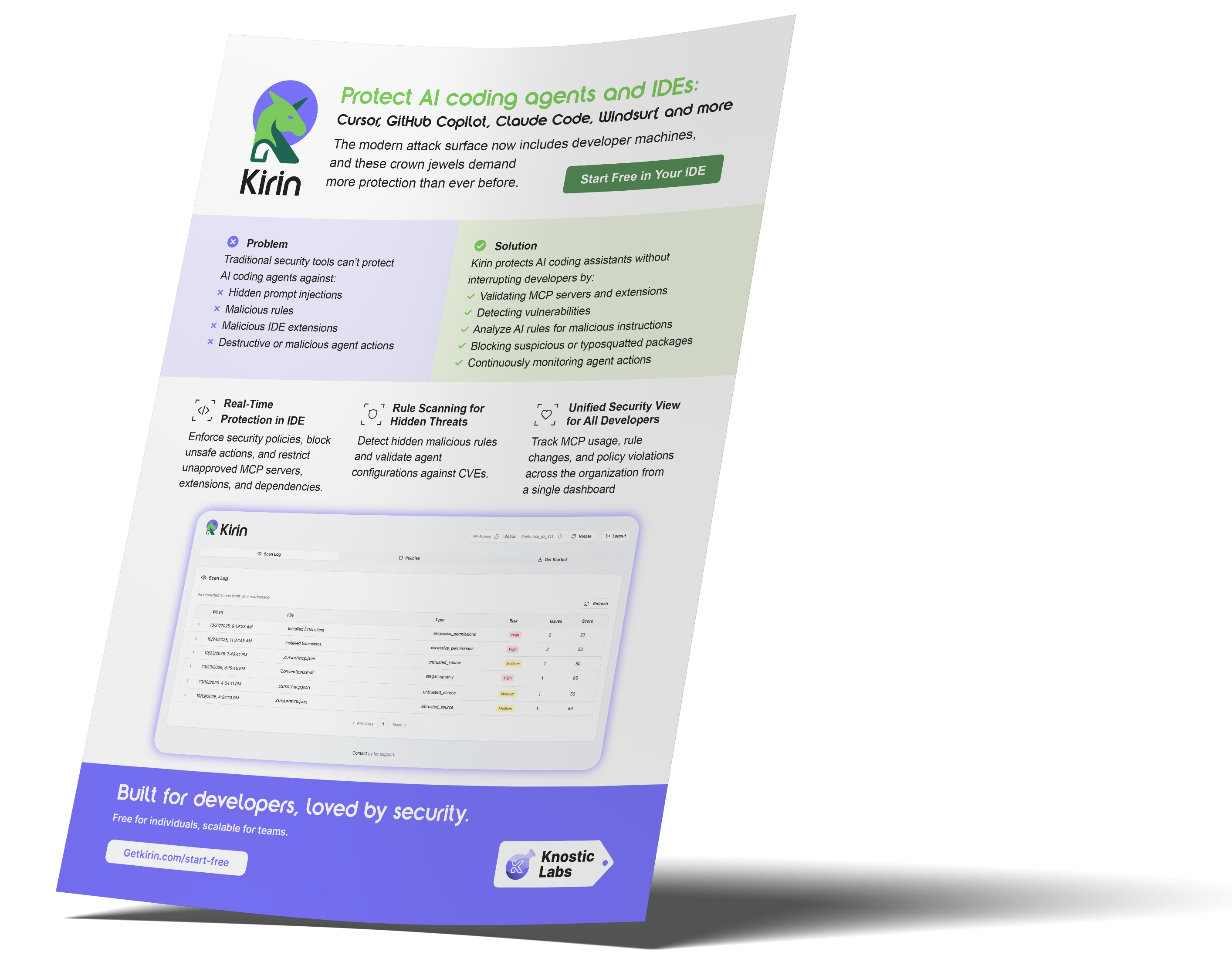
Secure Your AI Coding Environment
Discover how Kirin prevents unsafe extensions, misconfigured IDE servers, and risky agent behavior from disrupting your business.
Tags:
Shadow AI